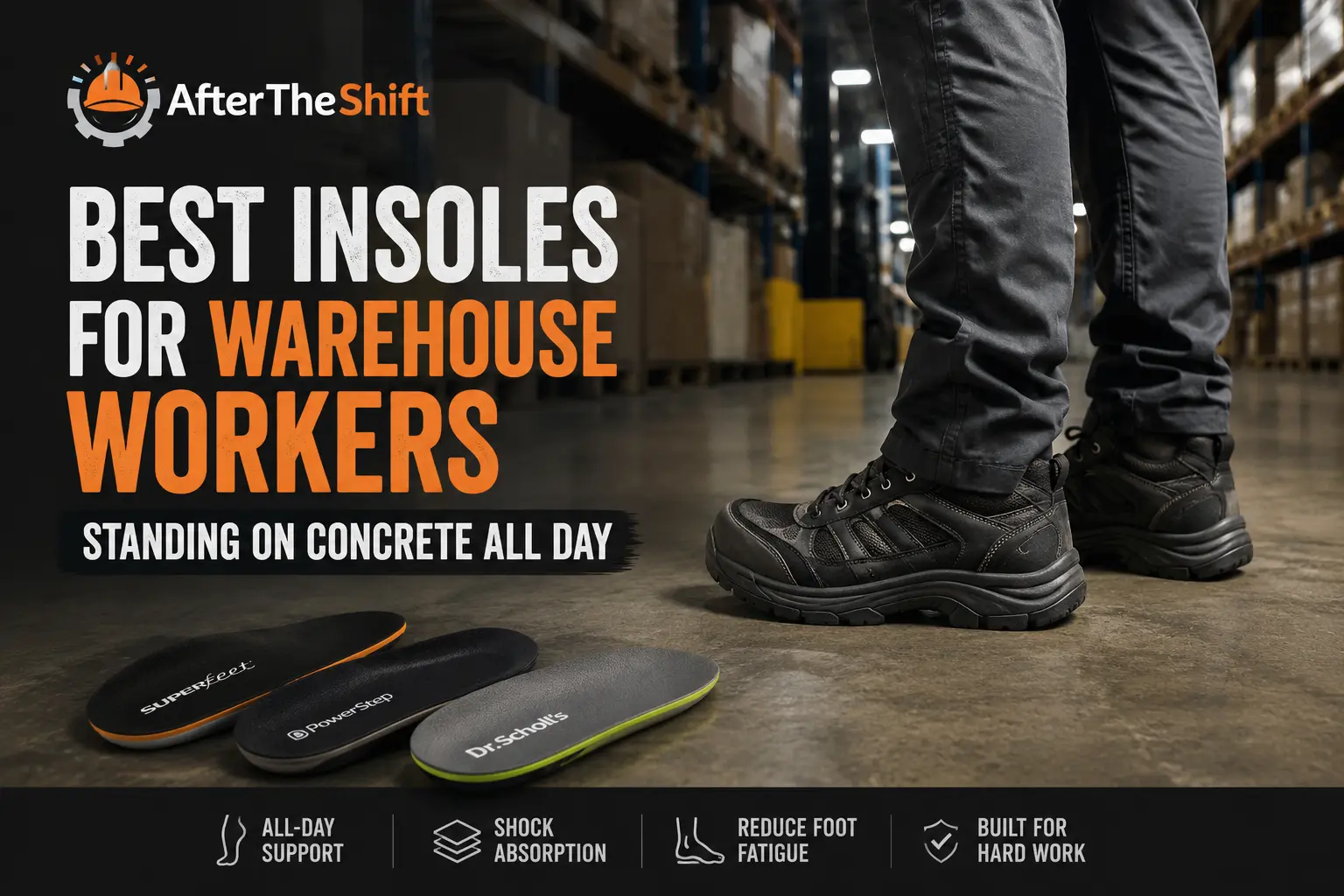
If concrete floors are beating up your feet before the shift is over, the right insole can add cushioning, support, and stability without forcing you into new work boots.
Home Construction + Warehouse + Trades Best Insoles for Warehouse Workers Standing on Concrete All Day
If your feet feel beaten up halfway through a warehouse shift, the problem is not automatically that your boots are “bad.” Concrete gives very little under repeated standing and walking, so the insole becomes one of the layers controlling cushioning, arch support, heel stability and how much room remains inside your work boot.
For most warehouse workers standing on concrete all day, the best insole is one that matches the actual problem rather than simply being the softest. Superfeet Work Cushion is the strongest all-round cushioning pick in this comparison; PowerStep Pinnacle Work suits workers wanting more structured arch support; Timberland PRO is a strong work-boot-focused option; Dr. Scholl's is the budget choice; KEEN K-20 targets cushioning with moderate support; and Spenco Total Support Max is the firmest support-oriented option.
Affiliate disclosure: As an Amazon Associate, After The Shift may earn from qualifying purchases made through links on this page, at no extra cost to you.
Start with Superfeet Work Cushion if your main problem is all-day hard-floor fatigue. Choose PowerStep Pinnacle Work instead if you specifically want firmer arch and heel structure rather than maximum softness.
- Match the insole to cushioning vs support needs.
- Remove the original footbed if the replacement is designed to replace it.
- Check toe room before wearing the new setup for a full shift.
- Replace compressed insoles instead of waiting for them to feel completely dead.
- Stacking thick insoles on top of each other.
- Buying maximum arch support just because it sounds better.
- Ignoring numb toes, severe swelling or sharp pain.
- Using an insert that makes a safety boot too tight.
If your boots fit correctly and your discomfort builds gradually from hours on hard flooring, test an insole matched to your need. If the insole creates pressure, numbness or less toe room, it is the wrong setup even if the product is highly rated.
| If you… | Start with | Why | Flag |
|---|---|---|---|
| Feel general sole and heel fatigue after hours on concrete | Superfeet Work Cushion | Cushion-first all-rounder | LOW |
| Want noticeably firmer arch and heel structure | PowerStep Pinnacle Work | More support-focused | LOW |
| Wear traditional work boots and want an anti-fatigue-style replacement | Timberland PRO | Work-boot-focused design | LOW |
| Want the cheapest reasonable upgrade first | Dr. Scholl's Work All-Day | Budget cushioning | LOW |
| Need cushioning but do not want extremely rigid support | KEEN Utility K-20 | Balanced middle option | CHECK FIT |
| Know you prefer firm, high-support insoles | Spenco Total Support Max | Firmest support-oriented pick here | SPECIFIC FIT |
| Have new numbness, weakness, major swelling, redness or sudden severe pain | Do not solve it by buying an insole | The symptom needs assessment first | HIGH |
This guide is for workers whose feet become tired, sore or uncomfortable during long periods of standing and walking on hard warehouse floors. It does not diagnose plantar fasciitis, nerve problems, circulation problems, fractures or other injuries. Persistent, severe, one-sided or neurological symptoms need a different decision path than simply changing insoles.
- Why concrete makes insole choice matter
- How warehouse job type changes the load
- The 6 best insoles compared
- Symptom → likely issue → first fix
- Interactive insole decision tree
- The 4 load stages
- 10-question insole upgrade test
- What actually helps before, during and after work
- Insole fit checklist
- Warehouse insole FAQs
Why Do Warehouse Workers Need Different Insoles for Concrete Floors?
Concrete does not deform meaningfully under your body weight, so your footwear has to manage most of the comfort, cushioning and support between your foot and the floor.
That does not mean concrete automatically “damages” your feet. The problem is exposure: hours of standing, thousands of repeated loading cycles from walking, tight work footwear, worn midsoles and compressed factory inserts can combine until the setup stops feeling tolerable.
An insole can change what happens inside the boot. It can add cushioning, alter how the arch and heel are supported, improve contact under the foot and replace a compressed factory footbed. It cannot make a badly fitting boot wide enough, restore a collapsed boot midsole or treat every source of foot pain.
| Shift exposure | Weekly hard-floor exposure | What tends to matter more | What an insole cannot fix |
|---|---|---|---|
| 8 hours × 5 days | 40 hours | Basic cushioning + correct fit | Boots that are too narrow |
| 10 hours × 5 days | 50 hours | Cushion durability + support match | A worn-out midsole |
| 12 hours × 5 days | 60 hours | Whole-footwear system matters | Medical red-flag symptoms |
The best insole for concrete is not automatically the thickest one. Extra thickness can improve cushioning but can also reduce toe-box volume and create pressure. The useful target is enough cushioning and support without changing how securely and comfortably the work boot fits.
If your whole footwear system feels dead, see why good work boots eventually stop cushioning properly. If the problem is broader foot soreness after the shift, use the foot pain after standing eight hours guide to separate simple fatigue from signs worth taking more seriously.
How Does Your Warehouse Job Change Which Insole You Need?
A picker walking all shift and a packer standing at one station load their feet differently, so the same insole can feel excellent to one worker and unnecessary to another.
| Job type | Foot-loading pattern | Main comfort risk | Compounding factor | Insole priority |
|---|---|---|---|---|
| Order picker | Repeated heel strike and toe-off | Whole-foot fatigue | Long walking distance | Cushion + stable heel |
| Packer | Long static standing | Heel/forefoot pressure | Few position changes | Pressure distribution + cushion |
| Dock/loading worker | Walking + carrying + direction changes | Fatigue and instability | Heavy footwear | Support + cushioning |
| Forklift operator | Mixed sitting, stepping and pedals | Less continuous foot loading | Repeated climbing in/out | Fit and moderate cushion |
| Maintenance / trades | Walking, ladders, kneeling, uneven positions | Pressure shifts around the boot | Rigid safety footwear | Secure fit first |
Workers spending most of the day on hard flooring should also see the longer-term context in standing on concrete all day: the workload timeline.
The 6 Best Insoles for Warehouse Workers on Concrete
For most workers, Superfeet Work Cushion is the best all-round starting point; PowerStep Pinnacle Work is the stronger support-first alternative.
These rankings use a practical warehouse-fit rubric rather than pretending every worker has the same foot: hard-floor comfort 30%, support 25%, work-footwear compatibility 20%, fit versatility 15%, and value 10%. The scores are editorial comparison scores, not laboratory measurements or medical ratings.
| Rank | Insole | Best for | Support feel | Skip if | Editorial fit score |
|---|---|---|---|---|---|
| 1 | Superfeet Work Cushion | General warehouse fatigue | Soft / cushioned | Your boot cannot spare interior volume | 9.2/10 |
| 2 | PowerStep Pinnacle Work | Arch + heel support | Firm but not maximum-rigid | You strongly dislike arch pressure | 9.0/10 |
| 3 | Timberland PRO Anti-Fatigue | Traditional work boots | Contoured / cushioned | Boot fit becomes cramped | 8.8/10 |
| 4 | KEEN Utility K-20 | Balanced cushioning and support | Medium | You require very firm control | 8.5/10 |
| 5 | Dr. Scholl's Work All-Day | Budget cushioning | Soft | You specifically need structured arch control | 8.2/10 |
| 6 | Spenco Total Support Max | Workers who already know they prefer firm support | Firmest here | You want a soft neutral cushion | 8.1/10 overall; higher for firm-support users |
Superfeet Work Cushion
Best starting point when your main complaint is general foot fatigue from long warehouse shifts rather than a specific need for rigid support.
Check Superfeet Work Cushion on Amazon →PowerStep Pinnacle Work
Better fit for workers who want a more structured arch and heel platform instead of buying purely for softness.
Check PowerStep Pinnacle Work on Amazon →Dr. Scholl's Work All-Day
The simpler choice when you mainly want extra cushioning and do not want to spend premium-insole money first.
Check Dr. Scholl's Work All-Day on Amazon →1. Superfeet Work Cushion — Best Overall for Long Warehouse Shifts
Best for: workers whose feet feel generally tired, flattened or beaten up after hours of standing and walking on hard floors.
This is the cleanest first recommendation for a warehouse worker who does not have a highly specific correction need. The product is positioned around all-day work, different arch heights and anti-fatigue cushioning, which makes it easier to recommend as an all-rounder than a very rigid orthotic-style insert.
Who should buy: pickers, packers, stock workers and tradespeople who mainly want a better layer between the foot and hard flooring.
Who should skip: anyone whose boot already feels tight over the toes or instep. More cushioning is not useful if the added volume creates compression.
Check Superfeet Work Cushion price and sizes on Amazon →
2. PowerStep Pinnacle Work — Best for Structured Arch Support
Best for: workers who want the insole to provide a more obvious arch and heel structure, not just padding.
PowerStep makes more sense when your buying decision is support-first. The product name specifically targets work-boot arch support and pronation-related support, so this is the better comparison point against soft foam or gel inserts.
Who should buy: workers who have used structured insoles before and know that moderate arch contact feels comfortable.
Who should skip: workers who dislike noticeable arch pressure or whose footwear has very little internal space.
Check PowerStep Pinnacle Work on Amazon →
3. Timberland PRO Anti-Fatigue Replacement Insole — Best for Work Boots
Best for: workers who want a work-focused replacement footbed rather than a general-purpose everyday shoe insert.
The Timberland PRO option sits between soft cushioning and highly rigid support. It makes particular sense when your footwear is already work-boot shaped and you want a replacement aimed at long periods on your feet.
Who should buy: workers wearing roomy work boots with removable factory footbeds.
Who should skip: anyone assuming that a Timberland-branded insole automatically fits every safety boot correctly. Fit still has to be checked.
Check Timberland PRO Anti-Fatigue Insoles on Amazon →
4. KEEN Utility K-20 Cushion — Best Balanced Work-Boot Option
Best for: workers wanting cushioning plus moderate support rather than either a very soft gel feel or a very firm orthotic feel.
This is the middle-ground pick. That makes it useful for workers who cannot decide between a cushion-first insert and a strongly structured one.
Who should buy: workers who want a work-footwear-oriented replacement with a more balanced feel.
Who should skip: workers who already know they require very firm arch control.
If you wear certified protective footwear, confirm that replacing the supplied footbed does not conflict with the footwear manufacturer's instructions, employer requirements or the certification of the shoe. Do not assume every aftermarket insole is neutral to safety-footwear performance.
Check KEEN Utility K-20 Cushion on Amazon →
5. Dr. Scholl's Work All-Day — Best Budget Insole
Best for: workers who want to test whether extra underfoot cushioning helps before spending more on a premium replacement insole.
The appeal here is simplicity. You get a work-focused, trim-to-fit insert without turning a basic comfort experiment into a large purchase.
Who should buy: workers with correctly fitting boots whose main complaint is tired, sore feet after long shifts.
Who should skip: workers specifically looking for a substantial structured arch-support platform.
Check Dr. Scholl's Work All-Day Insoles on Amazon →
6. Spenco Total Support Max — Best Firm-Support Pick
Best for: workers who already know they prefer firm arch support and more motion-control-style structure.
This is not the universal recommendation. Its value is that it gives the comparison a genuinely firmer option rather than six versions of soft cushioning.
Who should buy: experienced insole users who know that strong arch contact feels better to them.
Who should skip: first-time buyers looking for a soft, neutral warehouse cushion.
Check Spenco Total Support Max on Amazon →
Most workers: Superfeet Work Cushion. More arch structure: PowerStep Pinnacle Work. Traditional work-boot option: Timberland PRO. Budget: Dr. Scholl's. Balanced middle option: KEEN K-20. Firm support: Spenco Total Support Max.
Symptom → Cause → First Fix Matrix for Warehouse Foot Pain
Your symptom pattern should change the buying decision: general fatigue can justify an insole trial, while pressure, numbness and major swelling should make you inspect the boot or seek help rather than simply adding more padding.
| Symptom | Possible contributor | First fix | Insole direction | Red flag? |
|---|---|---|---|---|
| Feet feel generally tired after 6–10 hours | Hard-floor exposure + compressed cushioning | Inspect factory footbed and boot midsole | Cushion-first | Usually low |
| Heel/arch feels unsupported | Support mismatch | Test moderate structured support | PowerStep-type | Usually low |
| Toes become numb only after adding an insole | Reduced shoe volume / compression | Remove new insert and reassess fit | Thinner option or different footwear | Do not ignore |
| First steps after rest cause strong heel pain | Not just generic fatigue | Use heel-pain-specific decision path | Support may help, but diagnosis matters | Monitor |
| One foot suddenly swollen, hot or red | Potential medical issue | Seek prompt medical advice | Do not use an insole as the solution | YES |
| Sudden severe pain or cannot bear weight | Possible acute injury | Stop loading it and seek assessment | Not an insole problem | YES |
If your main symptom is painful first steps after sitting or sleeping, use the dedicated heel pain after standing all day guide. If toes are becoming numb inside work boots, see when tight work boots start irritating nerves before adding a thicker insert.
Do not keep experimenting with insoles if you develop sudden severe pain, cannot bear weight normally, have major or one-sided swelling, new weakness, persistent numbness, spreading redness/warmth, an open wound, or symptoms that are rapidly worsening. Workers with diabetes, known neuropathy or circulation problems should be more cautious about pressure and skin changes inside work footwear.
Which Warehouse Insole Should You Buy? Interactive Decision Tree
Use the decision tree below to route yourself by symptoms, safety-footwear constraints and whether you need cushioning or support.
Step 1: Do you have a red-flag symptom?
Examples: sudden severe pain, inability to bear weight, major one-sided swelling, new weakness, persistent numbness, redness/warmth or an open wound.
The 4 “Damage” Stages: When Foot Fatigue Stops Being Just an Insole Problem
The earlier discomfort appears and the longer it lasts after work, the less sensible it becomes to assume that a new insole alone will solve everything.
This is a practical workload triage framework, not a medical staging system and not a claim that every sore foot is being structurally damaged.
| Stage | What it feels like | What may be happening | Recovery pattern | Action |
|---|---|---|---|---|
| 1 — End-shift fatigue | Feet feel tired late in the day | Ordinary workload + footwear fatigue | Mostly better after rest | Inspect boot + trial better cushioning |
| 2 — Recovery lag | Soreness still obvious the next morning | Load may be exceeding recovery | Takes longer to settle | Address footwear, breaks and recovery together |
| 3 — Earlier-onset pain | Pain now appears earlier each shift | Ongoing irritation or unresolved workload issue | Days off no longer fully reset it | Stop relying only on gear changes |
| 4 — Red-flag change | Severe pain, swelling, numbness, weakness or inability to bear weight | Possible problem needing assessment | Not behaving like ordinary fatigue | Seek appropriate medical assessment |
10-Question Test: Are You a Good Candidate for an Insole Upgrade?
This test estimates whether your problem looks like a reasonable footwear-upgrade situation; it does not score injury severity.
If you have severe pain, major swelling, weakness, persistent numbness, redness/warmth or cannot bear weight normally, skip the quiz and deal with that first.
1. Do you stand or walk for at least six hours during many shifts?
2. Is concrete or another hard surface under you for most of the shift?
3. Does your current factory footbed feel thin, packed down or visibly worn?
4. Is your main problem general heel/sole fatigue rather than sudden sharp pain?
5. Does the discomfort improve substantially after rest or a day off?
6. Can the original insole be removed from your work shoe?
7. Do your toes currently have enough room without pressure or numbness?
8. Do your current boots otherwise fit securely without heel slip?
9. Does your job involve frequent walking, picking, packing or loading rather than mostly sitting?
10. Are you prepared to test the new insole briefly before committing to a full shift?
What Actually Helps Foot Fatigue — Before, During and After the Shift
An insole works best as one part of the footwear and recovery system, not as a patch for every problem created by long hard-floor shifts.
Before Work
- Check whether the insole lies flat.
- Confirm the heel is seated correctly.
- Make sure toes are not compressed.
- Use socks that do not create bunching.
- Replace a visibly worn factory footbed.
During Work
- Change stance instead of locking knees.
- Use permitted sitting or micro-breaks.
- Use anti-fatigue mats at fixed stations when available.
- Stop if a new insert causes numbness or rubbing.
- Notice whether pain arrives earlier each day.
After Work
- Get out of rigid work boots after the shift.
- Let footwear and footbeds dry fully.
- Use gentle movement instead of remaining completely still.
- Track symptoms that persist into the next morning.
- Escalate worsening symptoms rather than endlessly changing gear.
For the rest of the recovery system, use the physical work recovery guide or build a repeatable plan with the After The Shift routine builder.
Insoles vs New Boots vs Mats: Which Fix Should Come First?
Use an insole when the boot basically fits and functions; replace or reassess the boot when the footwear itself is the problem.
| Option | Best for | Skip if | Typical cost level |
|---|---|---|---|
| Cushioned work insole | General hard-floor fatigue | Boot is already too tight | $–$$$ |
| Structured support insole | Workers wanting stronger arch/heel support | Firm arches feel painful or intrusive | $$–$$$ |
| Replace work boots | Worn midsole, outsole or poor fit | Boot is still structurally sound and comfortable | $$$ |
| Anti-fatigue mat | Workers standing at one station | You walk continuously | $–$$ |
| Professional assessment | Persistent, worsening or unusual symptoms | Not something to skip when red flags are present | Varies |
Install the replacement footbed correctly, lace the boot normally, then stand, walk, squat and climb a few steps before wearing it for hours. If toe space disappears, your heel rises, the arch feels painfully intrusive or numbness begins, do not “break it in” through an entire shift.
10-Point Warehouse Insole Fit Checklist
A good insole should improve the underfoot setup without making the rest of the boot fit worse.
Bottom Line: Which Insole Should a Warehouse Worker Buy?
If you simply need a better insole for standing and walking on warehouse concrete, Superfeet Work Cushion is the best overall starting point from this six-product shortlist.
- Best overall: Superfeet Work Cushion
- Best structured support: PowerStep Pinnacle Work
- Best work-boot-focused option: Timberland PRO Anti-Fatigue
- Best balanced option: KEEN Utility K-20
- Best budget: Dr. Scholl's Work All-Day
- Best firm-support option: Spenco Total Support Max
Who should avoid simply buying another insole? Workers whose boots are too small, toe boxes are cramped, midsoles are worn out, symptoms are becoming progressively worse, or pain includes significant swelling, weakness, persistent numbness or other red flags.
FAQs About Insoles for Warehouse Workers
The most common mistakes are buying based only on softness, stacking inserts and ignoring the amount of space the replacement takes up inside a safety shoe.
Related Guides for Warehouse Foot and Leg Pain
Use the guide that matches the symptom your insole decision does not fully explain.
- Physical Work Recovery Guide — build the full recovery system
- Standing on Concrete All Day — the long-term workload timeline
- Foot Pain After Standing 8 Hours — when soreness needs a closer look
- Heel Pain From Standing All Day — why the first steps after rest hurt
- Numb Toes in Work Boots — when footwear pressure becomes a nerve problem
- Why Good Work Boots Stop Helping — what wears out inside them
- Build Your After-Work Recovery Routine
Next Steps
Do not buy six insoles. Identify your actual need, choose one category and test the fit properly.
- Check your current boots. If they are too tight or structurally worn out, solve that before adding another layer.
- Choose your category. Cushioning, structured support, work-boot-focused, budget or firm support.
- Most workers should start with Superfeet Work Cushion. Check the current Amazon listing and size options.
- If arch support is the priority, choose PowerStep Pinnacle Work instead. Check PowerStep Pinnacle Work on Amazon.
- Test the fit before a full shift. New cushioning is not a win if it creates toe pressure, numbness or heel slip.
- Track what happens after several shifts. Judge the insert by when discomfort starts, how strong it becomes and how quickly your feet recover afterward.
For general warehouse work on concrete, start with Superfeet Work Cushion. For firmer arch support, move to PowerStep Pinnacle Work. Do not solve a cramped or worn-out boot by adding more material inside it.
Bookmark the comparison so you can re-check the decision tree when your current footbeds start feeling flat again.
This article is general recovery education, not a diagnosis or a substitute for care from a qualified clinician. Stop and get medical help for severe pain, numbness, weakness, chest pain, sudden swelling, fever, or symptoms that keep worsening.
Log in to leave a comment.