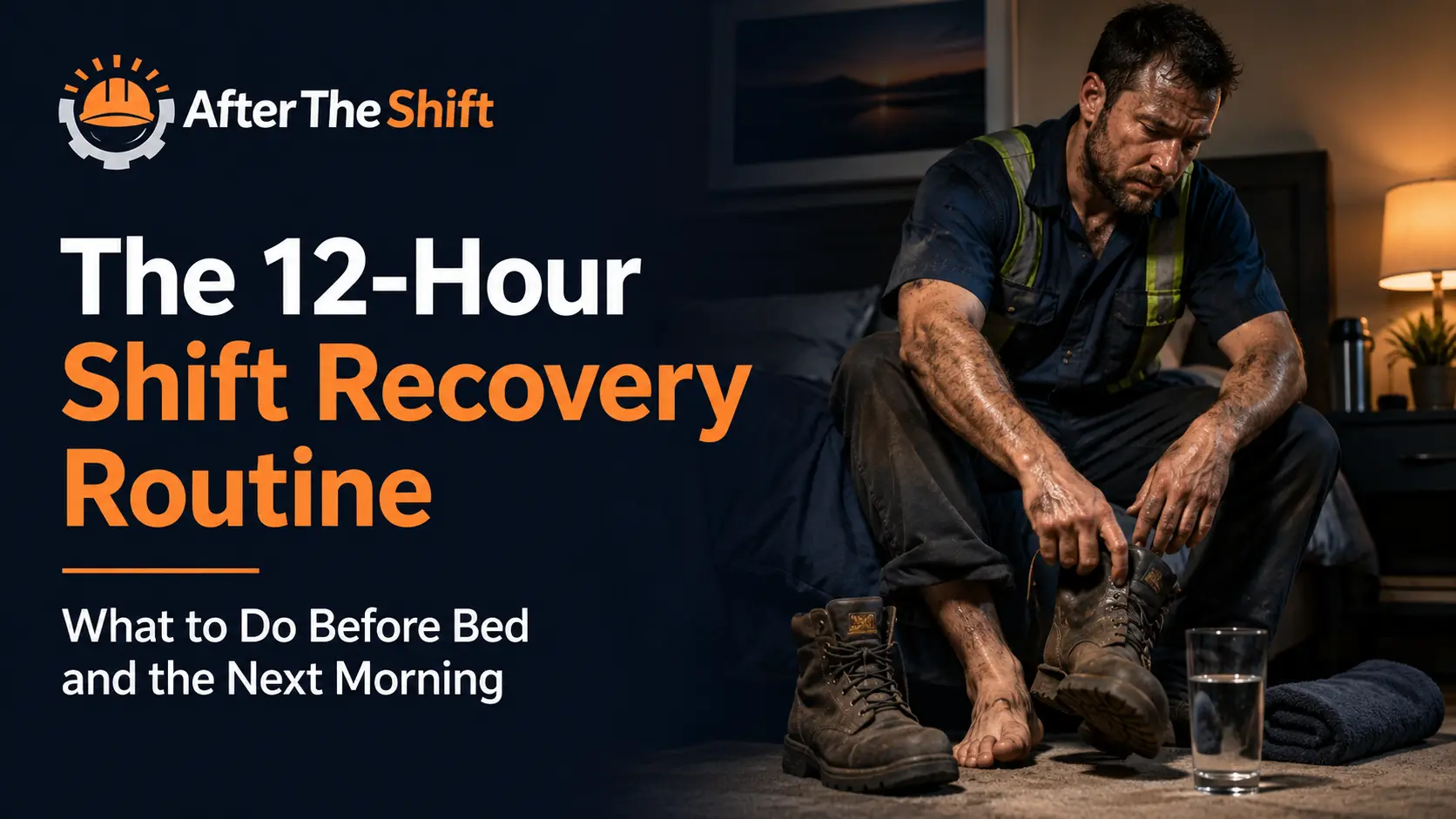
Finish a brutal 12-hour shift without letting stiffness, heavy legs, poor sleep, and next-morning soreness decide how your next day starts.
Home Recovery The 12-Hour Shift Recovery Routine
Affiliate note: Some product links in this guide are affiliate links. If you buy through them, After the Shift may earn a commission at no extra cost to you. Products are optional tools; the routine still works without buying anything.
After a 12-hour physical shift, recover in this order: calm down, eat and drink, unload the most fatigued areas, create a real sleep window, then use light movement the next morning instead of immediately attacking stiffness with aggressive stretching.
- Eat a normal meal with protein and carbohydrates.
- Replace fluids you lost during the shift.
- Use 5–10 minutes of easy mobility.
- Protect a 7–9 hour sleep opportunity when possible.
- Move gently for a few minutes after waking.
- Turning recovery into a 60-minute workout.
- Aggressively stretching a painful tendon or joint.
- Using alcohol as a sleep shortcut.
- Going straight from work stress to scrolling in bed.
- Ignoring swelling, weakness, numbness or worsening focal pain.
Fast Answer for Busy Workers: Your body does not need a complicated recovery ritual after every 12-hour shift. Give it food, fluid, a short transition out of work mode, gentle movement for the areas that have been loaded all day, and enough uninterrupted time to sleep. The next morning, start with movement before deeper stretching. If pain is becoming sharper, more localized, swollen, numb or harder to work around, stop treating it like ordinary shift fatigue.
If normal soreness clearly improves after sleep and easy movement, use the recovery routine. If one specific area keeps worsening, changes how you walk or work, or develops swelling, weakness or numbness, stop trying to “recover harder” and get it assessed.
| If you… | Best first move | Tonight | Next morning | Flag |
|---|---|---|---|---|
| Feel generally wrecked but nothing is sharply painful | Food + fluids + short mobility | Protect sleep time | 5-minute easy movement | LOW |
| Have heavy calves or tired feet after standing | Unload + gentle massage/rolling | Optional elevation | Walk before stretching | LOW |
| Wake stiff in the same areas every workday | Reduce repeated load + track pattern | Gentle mobility only | Movement + symptom check | MODERATE |
| Have one swollen, hot or increasingly painful area | Stop aggressive recovery work | Do not massage it hard | Reassess before work | HIGH |
| Have chest pain, unusual shortness of breath, new major weakness or severe one-sided leg swelling | Urgent medical assessment | Do not rely on this routine | Follow medical advice | URGENT |
Why does a 12-hour shift feel so much worse than an 8-hour shift?
A 12-hour shift gives you 50% more time on task than an 8-hour shift, and the extra four hours often happen after fatigue has already changed how you stand, lift, grip, walk and concentrate.
A physically demanding job is not one single stress. It is thousands of small exposures stacked together: footsteps, lifts, reaches, bends, tool grips, kneeling periods, vibration, awkward positions and hours spent standing on hard floors.
The important point is that physical strain does not necessarily rise in a perfectly straight line. The twelfth hour can feel disproportionately difficult because your movement quality, attention and local muscular endurance may already be worse than they were in hour two.
| Shift length | Time-on-task vs 8 hours | What can accumulate | Recovery priority |
|---|---|---|---|
| 8 hours | 100% | Routine fatigue | Normal meal, movement, sleep |
| 10 hours | 125% | More local muscular fatigue | Short deliberate recovery block |
| 12 hours | 150% | Fatigue + stiffness + movement compensation | Protect sleep and reduce unnecessary extra load |
The biggest recovery mistake after a long physical shift is treating recovery as another training session. A tired worker usually benefits more from food, hydration, low-intensity movement and sufficient sleep than from an aggressive stretching circuit, hard massage session or extra workout.
If you regularly feel destroyed despite getting enough hours in bed, see why eight hours of sleep may not fully fix physical-work fatigue.
How should recovery change for warehouse, construction, standing and repetitive jobs?
Your recovery routine should target the load your job actually creates instead of stretching your entire body equally.
| Job type | Main loading angle | Common end-of-shift pattern | Compounding factor | Recovery focus |
|---|---|---|---|---|
| Warehouse picking | Walking + bending + reaching | Feet, calves, low back | High repetition | Unload feet + easy hip/back movement |
| Construction/trades | Carrying + kneeling + overhead work | Knees, shoulders, back, forearms | Variable heavy loads | Local recovery by task exposure |
| Assembly/packing | Same motion repeated | Hands, wrists, neck, shoulders | Low variation | Change position; avoid more repetitive loading |
| Standing factory/retail | Static standing | Heavy feet, ankles, calves | Hard flooring | Walking, elevation, footwear review |
| Delivery work | Driving + repeated loading | Hip/back stiffness | Sitting between lifts | Walk first; restore comfortable range |
| Night shift | Physical load + circadian disruption | Body fatigue but difficulty sleeping | Light/noise/daytime obligations | Sleep environment becomes priority #1 |
For night workers, use the same physical recovery principles but pair them with the daytime sleep routine for night-shift workers.
What does your after-shift symptom actually need?
Use the symptom pattern—not how dramatic the soreness feels—to decide what to do next.
| Symptom | More likely pattern | First fix | Avoid | Red flag |
|---|---|---|---|---|
| Both legs feel generally heavy | Accumulated standing/walking fatigue | Walk briefly, eat, hydrate, optionally elevate | Hard leg workout | Marked one-sided swelling |
| Calves feel tight | Repeated calf loading | Easy walking + gentle massage | Forcing painful stretches | Hot, swollen, tender single calf |
| Feet ache diffusely | Long standing/walking exposure | Unload + gentle foot rolling | Digging hard into a painful spot | Unable to bear weight |
| Back feels stiff after sitting down | Fatigue + prolonged positions | Short walk + comfortable movement | Long static stretching if it worsens pain | New leg weakness or bladder/bowel symptoms |
| One tendon hurts in one exact spot | Possible local overload | Reduce aggravating load and monitor | Aggressive stretching/massage | Sudden pop, major swelling, loss of function |
| Numbness or tingling | Possible nerve compression/irritation | Remove pressure and reassess position/gear | Trying to “massage through” numbness | Persistent numbness or new weakness |
This routine usually applies to: ordinary muscular fatigue, generalized stiffness, tired feet and legs, and the “I worked for 12 hours and everything feels used” feeling. It does not replace assessment for: trauma, severe swelling, persistent numbness, progressive weakness, inability to bear weight, chest symptoms or pain that is repeatedly getting worse.
If the problem is specifically your lower legs, compare your symptoms with the guides to calf pain after standing all day and ankle pain after walking on concrete.
Decision tree: normal shift fatigue or something you should stop pushing?
Start with function and red flags before choosing massage, stretching, ice, elevation or sleep tools.
Do you have severe one-sided swelling, chest pain, unusual shortness of breath, new major weakness, a serious injury, or pain so severe you cannot use the area normally?
The 4 overload stages: when ordinary fatigue starts becoming a problem
The key change is not simply “more pain”; it is poorer recovery, more localization and declining function from shift to shift.
| Stage | How it feels | Pattern | Recovery | Action |
|---|---|---|---|---|
| 1 — Normal fatigue | Heavy, tired, broadly sore | Mostly after work | Clearly improves by next day | Standard routine |
| 2 — Accumulating overload | More stiffness in repeat areas | Symptoms appear most workdays | Not fully reset before next shift | Modify work/recovery inputs |
| 3 — Persistent focal problem | One joint/tendon/nerve area dominates | Earlier in each shift or present off work | Routine gives only temporary relief | Assessment + load change |
| 4 — Functional/red-flag stage | Weakness, major swelling, instability, severe pain or neurological symptoms | Function is affected | Ordinary recovery is inadequate | Medical assessment |
For a deeper distinction between ordinary soreness and a developing injury pattern, use the work pain vs injury guide.
10-question shift recovery check
This is a workload-screening tool, not a diagnosis: the higher your score, the less sensible it is to rely on sleep and self-recovery alone.
1. Is your discomfort concentrated in one exact area rather than general soreness?
2. Is the same problem appearing earlier in your shift than it used to?
3. Does pain change the way you walk, lift, grip or reach?
4. Do you still have significant symptoms after a normal sleep period?
5. Have the symptoms continued for more than a week of working shifts?
6. Do you have recurring numbness or tingling?
7. Is there visible swelling that repeatedly returns?
8. Does the problem now bother you on days off too?
9. Are you depending on painkillers or recovery gadgets just to get through normal shifts?
10. Do you feel less physically capable from week to week instead of adapting?
The exact 12-hour shift recovery routine: before bed and next morning
Your best routine is deliberately short: approximately 20–40 minutes of active recovery tasks spread around your normal meal, shower and bedtime—not another hour of work.
0–10 minutes after getting home: get out of work mode
Take off restrictive work gear, sit down only long enough to change, then move around the house for a couple of minutes. This is especially useful if your commute ended with prolonged sitting.
- Change shoes and socks.
- Walk for 2–5 easy minutes.
- Notice whether anything is sharply painful, swollen or numb.
- Do not immediately collapse into one position for the entire evening.
If your main complaint is whole-body stiffness after sitting in the car or on public transport, two to five minutes of relaxed walking is usually a better first step than dropping immediately into deep stretches.
10–30 minutes: eat and replace fluids
Do not make recovery nutrition more complicated than it needs to be. Eat a real meal containing a useful protein source, carbohydrate, and normal foods you tolerate well.
If the shift was hot or you sweated heavily, fluid replacement matters more than it does after a cool, low-sweat shift. Your goal is normal rehydration—not forcing litres of water into yourself immediately before bed.
20–35 minutes: target the area that actually worked hardest
Choose one or two areas, not your entire body.
- Heavy calves: gentle massage or rolling.
- Tired soles: easy foot rolling.
- Stiff ankles: comfortable ankle movement.
- Back stiff from bending: short walk and pain-free spinal/hip movement.
- Forearms tired from gripping: stop gripping things and move the wrists/hands gently.
For tired calves without acute swelling or sharp pain, the TriggerPoint Performance STK Target 15-Inch Massage Stick is an optional way to apply controllable pressure without getting onto the floor.
If the soles of your feet simply feel worked from standing, the TheraFlow Foot Massager gives you a simple rolling option. Use comfortable pressure; do not grind aggressively into a bruised, acutely painful or numb foot.
30–60 minutes before sleep: unload if your legs feel heavy
If both legs feel generally tired or mildly puffy after prolonged standing, lying down with your legs comfortably supported can be a low-effort way to finish the evening.
The TranquilRelax Leg Elevation Pillow is useful mainly for workers who otherwise end up stacking cushions that slide apart. It is optional; ordinary pillows can accomplish the same basic position.
Routine heaviness in both legs after standing is different from sudden or marked swelling in one leg, especially when it is painful, warm or red. Do not simply elevate, compress or massage unexplained one-sided swelling and assume it is ordinary work fatigue.
Last 30 minutes: protect sleep instead of chasing more recovery
Once the physical part of the routine is done, sleep becomes the main event. You do not gain much by spending another hour foam rolling if it steals an hour from an already short sleep window.
If light is the problem, the Manta Sleep Mask is a premium option with adjustable eye cups. Who should buy: people whose sleep space cannot be made consistently dark. Who should skip: anyone already sleeping in a genuinely dark room without light disturbing them.
If environmental noise keeps waking you or makes it difficult to settle, the LectroFan Evo White Noise Machine can provide continuous fan/white-noise sound. Who should buy: workers dealing with traffic, neighbours or daytime household noise. Who should skip: people whose room is already quiet.
The best pre-bed recovery routine after a 12-hour shift should make sleep easier, not delay it. Once you have eaten, hydrated, changed out of work gear and spent a few minutes moving the most fatigued areas, additional recovery work has diminishing value if it shortens your sleep opportunity.
Next morning, first 5 minutes: move before you judge the stiffness
How you feel during the first three steps out of bed is not always how you will feel 10 minutes later. Start with low-intensity movement.
- Stand and walk around for 2 minutes.
- Do 10 comfortable ankle pumps or circles per side.
- Move hips and shoulders through an easy range.
- Then reassess where the stiffness remains.
If your morning problem is mainly calf/ankle tightness, the StrongTek Wooden Slant Board can make gentle calf positioning easier. Use mild intensity. A slant board is not the right tool for forcing through sharp Achilles, calf or foot pain.
If morning stiffness itself is becoming a daily pattern, use the guide to waking up stiff after physical work.
Next morning, 5–15 minutes: decide whether today is normal, modified or stop-and-check
Ask three questions:
- Did the general fatigue improve?
- Can I move normally?
- Is one area becoming more painful, swollen, weak or numb?
If answers one and two are yes and three is no, continue normally. If one structure is deteriorating despite recovery, the answer is not automatically “more massage.”
Seek appropriate medical care for severe or rapidly worsening pain, major trauma, inability to bear weight, significant weakness, persistent neurological symptoms, severe one-sided swelling, chest pain or unusual shortness of breath. The urgency depends on the symptom and severity; this recovery routine is not designed to triage medical emergencies.
Recovery tools compared: what is actually worth buying?
Buy a recovery product only when it removes a specific obstacle in your routine; none of these products replaces adequate sleep, food, fluid, sensible workload or medical assessment when needed.
| Option | Best for | Skip / use caution if | Time | Cost level | Verdict |
|---|---|---|---|---|---|
| TriggerPoint STK Target | Tired calves/thighs | Acute injury, unexplained swelling, bruising | 3–5 min | Moderate | Useful if you actually massage consistently |
| TheraFlow Foot Massager | Tired soles after standing | Acute foot injury, numb areas, painful pressure | 2–5 min | Low–moderate | Simple and easy to use |
| TranquilRelax Leg Elevation Pillow | Comfortable leg support | You already have a stable pillow setup | 10–30 min | Moderate | Convenience, not necessity |
| Manta Sleep Mask | Light-contaminated sleep | Room already stays dark | All sleep period | Moderate | High value for day sleepers |
| LectroFan Evo | Unpredictable environmental noise | Quiet bedroom already | All sleep period | Moderate | Useful when noise is the actual problem |
| StrongTek Slant Board | Gentle calf/ankle mobility | Acute Achilles/calf/foot pain | 2–5 min | Moderate | Best as a mobility tool, not torture device |
| Physix Gear Calf Compression Sleeves | Workers who like mild calf support/compression | Poor fit, numbness, unexplained swelling or known circulation problems without medical guidance | Variable | Moderate | Optional—not a recovery requirement |
| REVIX XL Shin Ice Pack | Short-term cooling comfort after a particularly irritated lower-leg area | Numb skin, circulation problems, sleeping with ice applied | Short sessions | Moderate | Comfort tool, not a fix for repeated overload |
Do not buy eight recovery products. Identify the one bottleneck that repeatedly ruins your recovery—heavy legs, foot discomfort, light, noise or limited mobility—and solve that first. If the problem is persistent pain rather than inconvenience, spend the money on assessment instead of another gadget.
Before, during and after: what actually moves the needle?
What you do during the shift can matter as much as what you do afterward because recovery cannot completely erase a badly managed 12-hour exposure every night.
Before shift
- Wear workable footwear.
- Start reasonably hydrated.
- Eat enough to avoid running empty.
- Know which body area is already irritated.
During shift
- Change position when the job allows it.
- Do not save every drink and meal for the end.
- Notice symptoms getting earlier each day.
- Avoid unnecessary extra load when already fatigued.
After shift
- Move gently before becoming sedentary.
- Eat and replace fluids.
- Target only the areas that need attention.
- Protect the sleep window.
If you want a routine customized around your own problem areas, use the After the Shift recovery routine builder.
Printable 12-hour shift recovery checklist
A good checklist should fit into your normal evening instead of becoming another task you resent doing.
Bottom line
The best 12-hour shift recovery plan is boring on purpose: eat, hydrate, move gently, target only the areas that need attention, make sleep easy, and reassess function the next morning.
- Best choice for normal soreness: short active recovery + adequate sleep.
- Best product strategy: buy only the tool that solves your actual bottleneck.
- Best morning strategy: move first, then decide whether stretching is even needed.
- Who should modify the routine: workers with a specific irritated joint, tendon or nerve area.
- Who should not rely on this routine: anyone with severe, worsening or red-flag symptoms.
If you consistently need more and more recovery work just to return to baseline before the next shift, the problem is no longer simply your recovery routine. The balance between workload and recovery has changed, and the work exposure itself needs to be reviewed.
12-hour shift recovery FAQs
These answers cover the questions workers most often run into when trying to recover between long shifts.
Related recovery guides
Use the next guide based on what is still limiting you after you complete the basic routine.
- Physical Work Recovery Guide — the main hub for recovery after demanding jobs.
- Build your own worker recovery routine — use your symptoms and work exposure to choose next steps.
- Why 8 hours of sleep does not always fix physical-work fatigue — for workers sleeping enough but still waking wrecked.
- Waking up stiff after physical work — if the morning is worse than bedtime.
- Calf pain after standing all day — when your lower legs are the weak point.
- How to sleep during the day after a night shift — for workers recovering while the rest of the world is awake.
Next steps
Do not try to fix everything tonight. Use the result of tonight's routine to decide tomorrow's move.
- Tonight: run the short recovery routine without adding unnecessary exercises.
- Tomorrow morning: check whether generalized fatigue has clearly improved.
- If one area remains: use the symptom-specific guide for that body part.
- If your whole body never resets: use the physical-work recovery guide and review sleep, food, shift spacing and workload.
- If symptoms are worsening or affecting function: stop treating the problem as routine soreness and get appropriate assessment.
Build the routine around the problem—not the products.
Use the After the Shift routine builder to turn your actual job, sore areas and shift pattern into a shorter recovery plan.
Build My Recovery Routine →Bookmark this page now so you do not have to remember the steps when you get home exhausted.
This article is general recovery education, not a diagnosis or a substitute for care from a qualified clinician. Stop and get medical help for severe pain, numbness, weakness, chest pain, sudden swelling, fever, or symptoms that keep worsening.

Log in to leave a comment.