The damage timeline for construction workers who want to catch pain early, fix weak links, and stay useful without wrecking their body.
Construction worker body breakdown usually does not start with one dramatic injury. It starts with small repeat hits: lifting with fatigue, kneeling without recovery, reaching overhead, gripping tools, standing on hard surfaces, and ignoring pain that keeps returning. By year 3, pain often shows up as stiffness and tendon irritation. By year 5, it can become recurring back, knee, shoulder, wrist, or foot trouble. By year 10, the risk shifts toward chronic joint wear, nerve symptoms, and work limits.
Construction work breaks bodies down fastest when the same tissues are overloaded every week without enough recovery. The usual timeline is year 3 for warning pain, year 5 for recurring injury patterns, and year 10 for chronic wear unless the worker changes load, tools, technique, sleep, and recovery.
- Track pain that repeats for more than 2 weeks.
- Rotate tasks before one joint becomes the weak link.
- Use knee pads, lifting aids, carts, handles, and better grip tools.
- Fix sleep, food, hydration, and mobility before pain becomes normal.
- Calling daily pain “just the job.”
- Waiting until numbness, swelling, or weakness appears.
- Using painkillers to push through the same bad workload.
- Blaming age when the real cause is repeated overload.
If the same pain returns every shift or every week, treat it as a workload problem now — not as soreness you can wait out for another year.
| If you… | Most likely stage | Risk flag | What to do first |
|---|---|---|---|
| Feel stiff after shifts but recover by morning | Early overload | Low | Improve sleep, hydration, footwear, warm-up, and task rotation. |
| Get the same knee, back, shoulder, or wrist pain every week | Year 3 warning pattern | Moderate | Reduce the repeated movement and fix the tool, angle, or recovery gap. |
| Need braces, painkillers, or “warm-up time” to work normally | Year 5 recurring injury | High | Get assessed and change duties before the tissue keeps flaring. |
| Have numbness, weakness, swelling, locking, or pain at rest | Possible injury or nerve/joint involvement | High | Stop guessing and get medical help or occupational health input. |
Why Construction Work Breaks the Body Down
Construction worker body breakdown happens when force, repetition, awkward posture, vibration, and poor recovery hit the same tissues faster than they can repair.
This usually applies to workers who lift, carry, kneel, climb, drill, grind, cut, reach overhead, push wheelbarrows, move materials, or stand on hard surfaces for most of the day. It does not apply to sudden trauma such as falling from height, being struck by equipment, or a fresh accident injury. Those need a separate safety and medical pathway.
The main cause of construction body breakdown is cumulative musculoskeletal load: repeated force, awkward positions, vibration, and insufficient recovery. NIOSH describes work-related musculoskeletal disorders as problems affecting muscles, nerves, tendons, ligaments, joints, cartilage, or spinal discs linked to force, repetition, vibration, or awkward posture. :contentReference[oaicite:0]{index=0}
| Load type | What it does | Common construction example | Body part usually hit first |
|---|---|---|---|
| Heavy force | Compresses joints and overloads tissue | Carrying bags, blocks, boards, tools | Lower back, knees, elbows |
| Repetition | Irritates tendons and nerves | Drilling, cutting, screwing, troweling | Wrist, thumb, shoulder, elbow |
| Awkward posture | Loads joints at weak angles | Overhead work, twisting, low work height | Neck, shoulders, back, hips |
| Vibration | Stresses nerves, blood flow, and grip tissue | Breakers, grinders, compactors, drills | Hands, wrists, elbows, shoulders |
| Poor recovery | Turns soreness into recurring pain | Bad sleep, low calories, no rest days, second jobs | Whole body |
This article is general guidance for recurring work pain and early injury patterns. It is not a diagnosis. Severe pain, traumatic injury, numbness, major swelling, weakness, chest symptoms, fever, or pain that wakes you repeatedly at night needs professional assessment.
The Year 3, 5, and 10 Construction Injury Timeline
The timeline is not exact, but many workers notice a pattern: year 3 brings repeated warning pain, year 5 brings recurring flare-ups, and year 10 brings chronic limits if nothing changes.
| Work year | What often shows up | What it means | Best move |
|---|---|---|---|
| Year 1–2 | General soreness, foot pain, lower-back tightness, hand fatigue | Body is adapting, but weak links are forming | Build recovery habits before pain becomes normal. |
| Year 3 | Same pain returning in the same joint or tendon | Local tissue is failing to recover between loads | Change the repeated movement, tool, angle, or volume. |
| Year 5 | Recurring back, knee, shoulder, wrist, elbow, or foot flare-ups | The body has a predictable failure pattern | Treat the root cause, not just the painful day. |
| Year 10+ | Chronic stiffness, nerve symptoms, joint swelling, loss of range, slower recovery | Wear and compensation patterns may be established | Protect earning capacity: modify tasks, get assessed, and strengthen weak links. |
Year 3 pain is usually a warning pattern, not proof that your body is “finished.” It means one area is being loaded too often, too hard, or at the wrong angle. The fix is not only rest; the fix is reducing the repeated stress that keeps restarting the same irritation.
How Job Type Changes the Damage Pattern
Different construction jobs break the body in different ways because each trade repeats different angles, loads, grips, and postures.
| Job type | Main angle/load | Body part at risk | Compounding factor |
|---|---|---|---|
| General labourer | Carry, shovel, lift, drag | Lower back, knees, shoulders | Task variety hides total daily load. |
| Flooring / tiling | Kneeling, squatting, forward bend | Knees, hips, lower back, wrists | Long static positions with few posture breaks. |
| Drywall / ceiling / overhead work | Arms up, neck extension, repetitive reaching | Shoulders, neck, upper back | Rotator cuff fatigue changes shoulder mechanics. |
| Concrete / masonry | Heavy materials, vibration, forceful grip | Hands, elbows, back, knees | Vibration plus heavy force accelerates fatigue. |
| Carpentry / framing | Grip, carry, saw, nail, reach | Wrists, elbows, shoulders, back | High repetition mixed with awkward cuts and carries. |
OSHA describes ergonomics as fitting the job to the person to reduce muscle fatigue and work-related musculoskeletal disorders; that matters on construction sites because many fixes are not complicated — better handles, mechanical aids, work-height changes, and task rotation can reduce physical demand. :contentReference[oaicite:1]{index=1}
Symptom → Cause → Fix Matrix
Use the symptom pattern to find the most likely overloaded tissue and the first practical fix.
| Symptom | Likely cause | First fix | Red flag |
|---|---|---|---|
| Lower back locks up after work | Repeated bending, twisting, loaded carries | Break the bend-reach-twist-lift pattern and add short hip/back resets. | Leg weakness, numbness, bladder/bowel changes |
| Knees ache after kneeling or stairs | Compression, cartilage irritation, tendon overload | Use knee pads, change kneeling intervals, strengthen hips and quads. | Swelling, locking, giving way |
| Shoulder pain with overhead work | Rotator cuff fatigue and poor shoulder position | Lower work height when possible and reduce overhead time blocks. | Loss of strength or night pain |
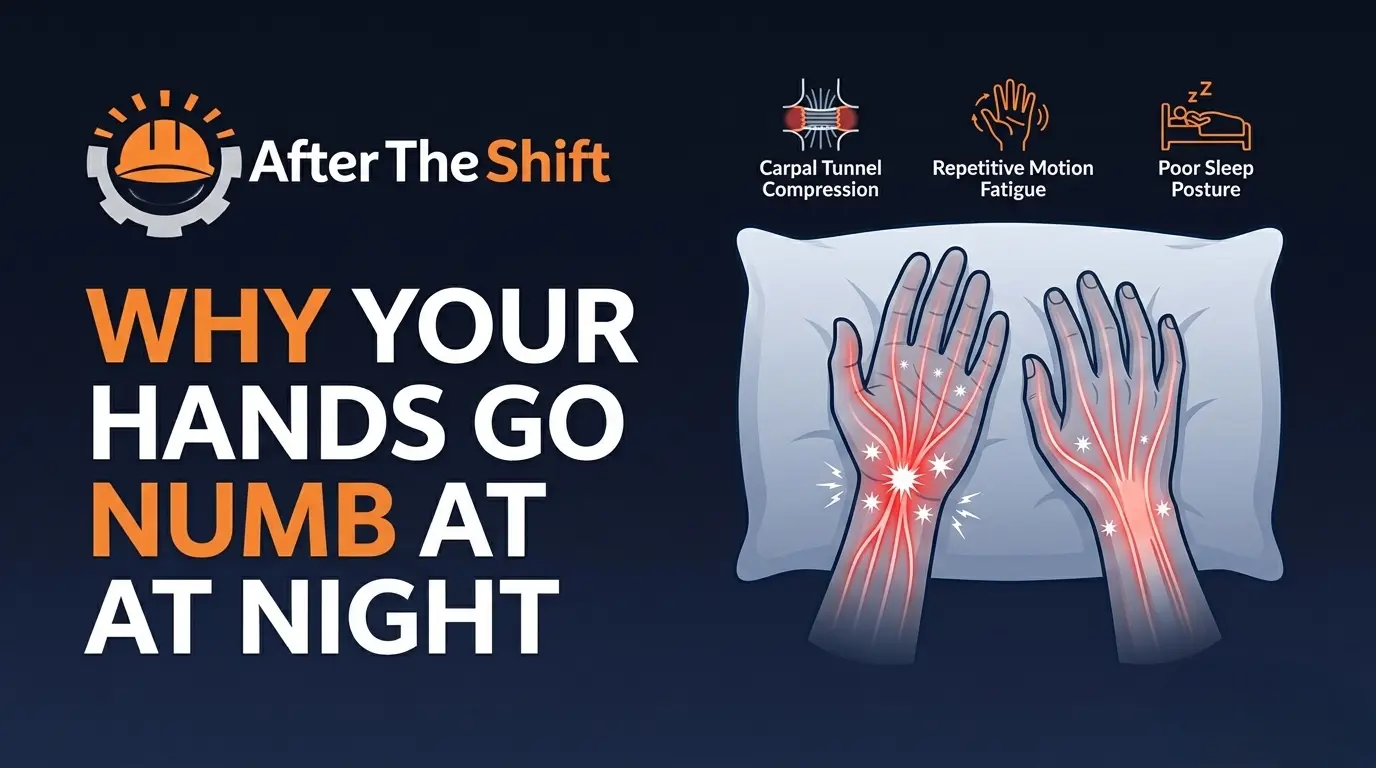
| Hands go numb or tingle | Nerve irritation from grip, vibration, wrist angle, or neck load | Reduce vibration exposure, neutralize wrist angle, avoid death-grip tools. | Weak grip, constant numbness, dropping tools |
| Feet hurt worse after stopping | Hard-surface load, poor boot support, calf/plantar tension | Replace worn insoles, rotate standing positions, add calf/foot recovery. | Sharp heel pain or swelling |
If construction pain appears in the same place after the same task, the task is part of the injury pattern. Back pain after bending, knee pain after kneeling, shoulder pain after overhead work, and hand numbness after vibration or gripping should be treated as specific workload signals, not random soreness.
Decision Tree: Normal Soreness or Early Body Breakdown?
This decision tree sorts pain into three routes: normal recovery, warning pattern, or stop-and-get-help risk.
Step 1: Did the pain start after a fall, impact, twist, pop, or accident?
The 4 Damage Stages
The safest time to fix construction body breakdown is before pain becomes your normal baseline.
| Stage | How it feels | What may be happening | Recovery window | Action |
|---|---|---|---|---|
| 1. Soreness | General ache after a hard day | Normal fatigue and tissue stress | 24–48 hours | Sleep, eat, hydrate, move lightly. |
| 2. Repeat pain | Same place, same task, every week | Local tissue overload | 1–3 weeks if load changes | Find and reduce the trigger task. |
| 3. Flare cycle | It improves, then comes back stronger | Recovery never catches up | Weeks to months | Assess, modify duties, strengthen weak link. |
| 4. Chronic limit | Pain changes how you work and live | Joint, tendon, nerve, or compensation pattern may be established | Longer and more individual | Get professional help and protect your earning capacity. |
Pain that changes your gait, grip strength, sleep, range of motion, or ability to work safely is not “just soreness.” That is the line where waiting becomes expensive.
Mini-Test: Your Construction Body Breakdown Score
This 10-question test ranks your current breakdown risk by recurring symptoms, recovery speed, and work interference.
Answer yes or no:
1. Does the same pain return every week?
2. Do you need time to “warm up” before moving normally?
3. Do you use braces, wraps, painkillers, or tape to get through normal shifts?
4. Do your hands go numb, tingle, or feel weak?
5. Do your knees swell, lock, click painfully, or give way?
6. Does pain affect your sleep after work?
7. Do you avoid certain tasks because one body part feels unreliable?
8. Does soreness last longer than 48 hours after a normal shift?
9. Has your pain moved from “after work” to “during work”?
10. Are you recovering worse this year than last year?
What Actually Fixes It — By Phase
The fix depends on timing: before work you prepare tissue, during work you reduce load spikes, and after work you recover before the next shift.
Before shift
- Eat enough to work, not just survive.
- Hydrate before sweating starts.
- Warm up hips, shoulders, wrists, and ankles for 3–5 minutes.
- Check boots, insoles, gloves, knee pads, and tool setup.
During shift
- Rotate high-risk tasks before pain starts.
- Use carts, handles, lifts, and team carries when available.
- Break static kneeling, overhead, and bent positions.
- Change grip pressure; stop death-gripping tools.
After shift
- Walk lightly before collapsing on the sofa.
- Stretch only what feels tight; do not force painful tissue.
- Eat protein and carbs so repair has materials.
- Sleep early enough to recover before the next load.
The fastest fix for early construction body breakdown is not one stretch. It is removing the repeated trigger while improving recovery. A painful shoulder from overhead work needs less overhead exposure. A painful knee from kneeling needs kneeling protection and interval changes. A painful back from bending needs task-height and lifting-pattern changes.
Treatment Options Compared
Treatment works best when it matches the stage; the wrong option can hide pain while the workload keeps causing damage.
| Option | Best for | Skip / be careful if | Cost/time trade-off |
|---|---|---|---|
| Rest day | General soreness and fatigue | The same task restarts the pain every week | Cheap, but incomplete without load changes. |
| Braces / wraps | Short-term support during a flare | You use them to ignore worsening symptoms | Low cost; can become a crutch. |
| Physio / rehab | Recurring tendon, joint, back, or movement problems | You refuse to change the triggering workload | Costs more, but protects long-term earning ability. |
| Tool/workstation changes | Pain caused by angle, grip, force, height, or repetition | The injury already has red flags | Often best return on effort. |
| Medication | Short-term pain control when appropriate | It becomes your main work strategy | May hide signals; ask a clinician if unsure. |
Printable Checklist: Stop Year 3 Pain Becoming Year 10 Damage
Use this checklist for one week and look for the repeated trigger, not just the worst pain day.
What This Applies To — And What It Does Not
This guide applies to recurring work-related body pain, not sudden accidents or serious medical symptoms.
- Construction workers with repeated aches.
- Workers in year 1–10 trying to prevent chronic damage.
- Back, knee, shoulder, wrist, hand, foot, and neck patterns.
- Workers who want practical workday changes.
- Falls, crush injuries, fresh trauma, or sudden severe pain.
- Chest pain, fainting, fever, unexplained weight loss, or severe illness.
- Loss of bladder/bowel control or major neurological symptoms.
- Replacing medical care when red flags are present.
Related Guides That Complete the Fix
Use these next if one body area is already becoming your weak link.
- Physical work recovery guide for building a full after-shift routine
- The real cost of physical work on the body over 10 years
- Standing on concrete all day and the damage timeline from month 1 to year 5
- Lower back pain from lifting and the positions that wreck your spine
- Kneeling tasks that cause the most long-term construction damage
- Shoulder pain from overhead work and why it gets worse every month
- Why hands go numb at night after physical work
FAQs
These answers cover the common edge cases: pain timing, safety, cost, myths, and when to stop working.
Bottom Line
The best choice is to treat repeated construction pain as a workload signal early, before it turns into a recurring injury cycle.
Best move: track the repeated pain, identify the trigger task, reduce the load, improve recovery, and get help when red flags appear. Do this if: pain returns weekly or affects work quality. Avoid waiting if: you have numbness, weakness, swelling, locking, giving way, or pain after an accident.
Next Steps
Use the next 7 days to find the pattern before it becomes another year of “normal pain.”
- Pick your main weak link: back, knees, shoulders, hands, feet, or neck.
- Write the trigger task: kneeling, overhead work, carrying, gripping, vibration, standing, twisting, or bending.
- Change one load factor: tool, height, grip, carry distance, break timing, knee protection, or task rotation.
- Fix recovery: eat after work, hydrate, sleep earlier, and walk lightly before collapsing.
- Recheck in 7 days: if the same pain is still repeating, use the related guide for that body part or get assessed.
If your main problem is full-body fatigue instead of one painful joint, start with the guide on why 8 hours of sleep does not fix physical work fatigue. If your pain is already changing how you work, read work pain vs injury and how to know the difference.
Save this before your next shift. When the same pain shows up again, use the table and checklist instead of guessing.
This article is general recovery education, not a diagnosis or a substitute for care from a qualified clinician. Stop and get medical help for severe pain, numbness, weakness, chest pain, sudden swelling, fever, or symptoms that keep worsening.

Log in to leave a comment.