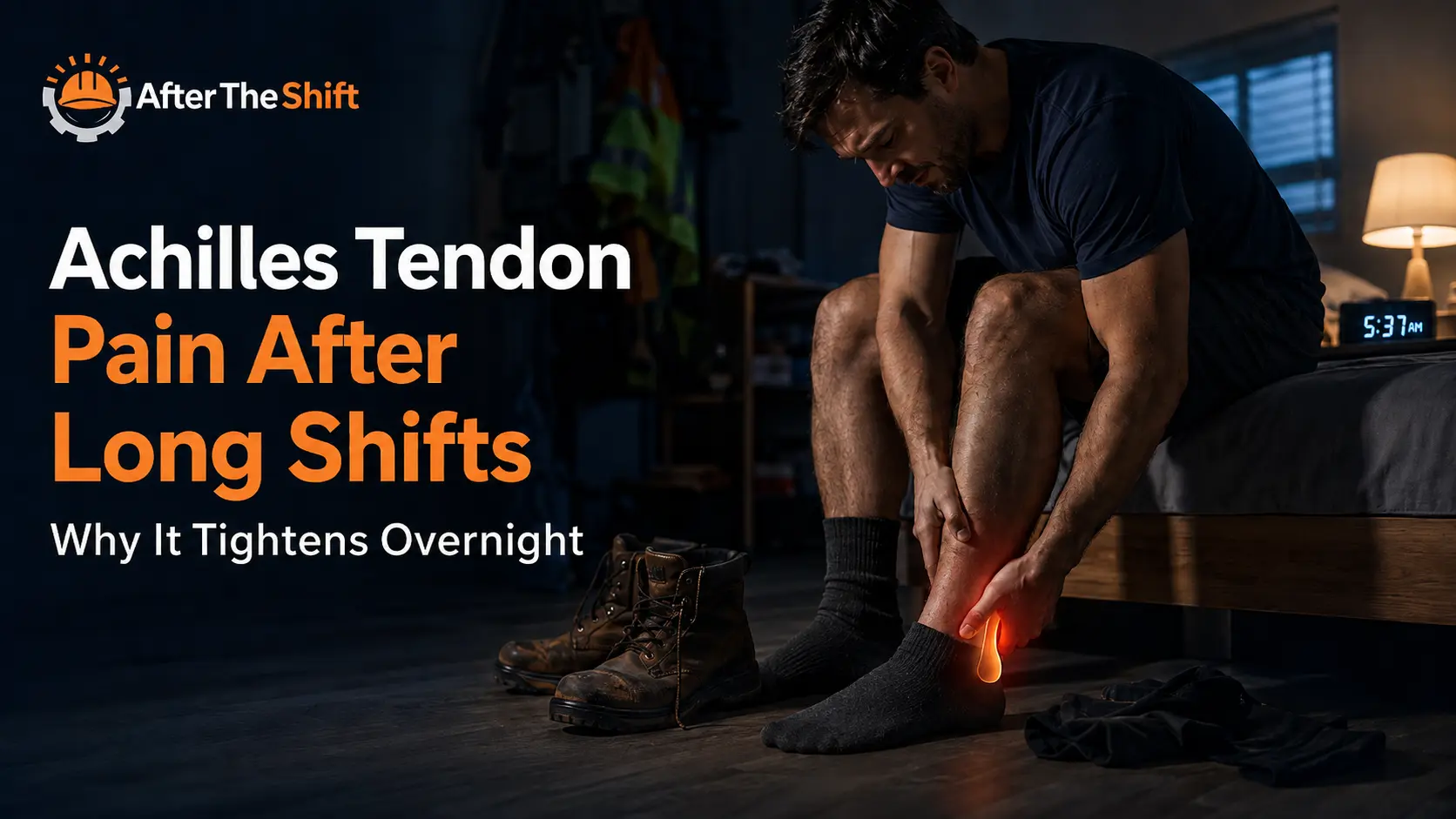
If your Achilles feels tighter on the first steps out of bed than it did leaving work, use this guide to find the likely load problem, reduce the next-shift flare-up, and know when
Home → Injuries & Prevention → Achilles Tendon Pain After Long Shifts
If your Achilles feels tighter on the first steps out of bed than it did leaving work, use this guide to find the likely load problem, reduce the next-shift flare-up, and know when to stop pushing.
This guide is for warehouse workers, construction workers, tradespeople, retail staff, drivers, cleaners and anyone spending long shifts walking, climbing, pushing off the toes or standing in work boots. It covers gradual Achilles pain and stiffness associated with repeated loading. It does not replace medical assessment after a sudden injury, snap, pop, major bruising, severe swelling or sudden loss of push-off strength.
Achilles tendon pain after a long shift often feels tighter overnight because an already load-sensitive tendon has spent several hours relatively still and is then asked to take body weight again immediately. The tendon is not simply “shrinking” while you sleep. Morning stiffness that eases after gentle movement can fit an Achilles tendinopathy pattern, but worsening pain, declining strength or sudden traumatic symptoms change the recommendation.
If the tendon is stiff after sleep but loosens with gentle walking, the first target is usually load management plus progressive calf/Achilles strengthening — not complete rest and not aggressive stretching.
- Reduce the part of the shift that clearly spikes symptoms.
- Warm the ankle up before the first hard push-off.
- Build calf strength progressively.
- Track how the tendon feels the next morning.
- Forcing painful stretches first thing in the morning.
- Repeatedly “testing” it with hard toe raises.
- Working through a worsening limp.
- Ignoring a sudden pop, snap or loss of push-off.
If movement makes the tendon gradually feel easier and your function stays normal, manage the load and rebuild capacity. If pain is making you limp, weakening push-off, worsening each morning or followed a snap/pop, stop treating it like ordinary shift soreness.
| If you… | Most useful interpretation | What to do next | Flag |
|---|---|---|---|
| Feel stiff for the first few steps after sleep, then loosen up | Common load-sensitive Achilles pattern | Modify load + begin controlled strengthening | LOWER |
| Feel worse the morning after every hard shift | Your current workload may exceed recovery capacity | Reduce the biggest trigger and monitor 24-hour response | MODERATE |
| Have pain that no longer warms up or is affecting your walking | Higher irritability or another problem needs consideration | Arrange GP, physiotherapy or MSK assessment | HIGH |
| Felt a sudden snap/pop and now cannot push off or rise normally onto the toes | Possible Achilles rupture | Urgent medical assessment | URGENT |
This usually applies to gradual pain or stiffness around the Achilles after repeated walking, standing, stairs, ladders or push-off work. It does not mean every pain behind the ankle is Achilles tendinopathy. Heel bursitis, calf injury, nerve symptoms, ankle problems and acute tendon tears can produce different patterns.
- Why the Achilles tightens after a long shift
- How your job changes the load
- Symptom → cause → fix matrix
- Interactive decision tree
- The 4 practical damage stages
- 10-question Achilles load test
- What actually fixes it before, during and after work
- Treatment options compared
- Shift recovery checklist
- Achilles pain FAQ
Why Does the Achilles Tendon Feel Tighter Overnight After a Long Shift?
The simplest explanation is that the tendon has been repeatedly loaded all shift, becomes sensitive to that load, then feels stiff when you ask it to carry weight again after several hours of inactivity.
The Achilles tendon connects the calf muscles to the heel bone. Every normal step asks it to transfer force from the calf into the foot. Walking faster, climbing stairs, pushing a pallet jack, carrying weight uphill, climbing ladders or repeatedly rising onto the toes increases that demand.
That does not mean every hard shift is damaging the tendon. Tendons are designed to take load. The problem starts when the load you repeatedly demand is greater than the load the tendon is currently prepared to tolerate.
Morning Achilles stiffness does not automatically mean the tendon was injured while you slept. A load-sensitive Achilles often feels worse after inactivity and easier after a few minutes of gentle movement. The more useful question is whether function and next-morning symptoms are stable, improving or progressively getting worse.
| Workload | What the Achilles does | Why it can become a problem |
|---|---|---|
| Standing | Maintains ankle stability | Long exposure with little movement variation |
| Walking | Transfers force during push-off | Thousands of repeated loading cycles |
| Stairs/ladders | Produces stronger calf-driven push-off | Higher force per repetition |
| Carrying loads | Handles body weight plus external load | Same movement with greater total force |
| Hard acceleration | Rapidly transmits calf force | Large force spike compared with normal walking |
Mid-portion vs insertional Achilles pain
Location matters because exercise choice can change. Mid-portion Achilles pain is usually felt a few centimetres above the heel. Insertional Achilles pain is concentrated where the tendon attaches directly to the back of the heel bone.
If the pain is right at the heel attachment, aggressively lowering the heel far below the level of a step can compress the irritated insertion. A flat-floor heel raise is often the safer starting position until you have professional guidance.
Which Physical Jobs Put the Most Load on the Achilles?
The highest-risk work pattern is not simply “standing all day”; it is long exposure combined with repeated push-off, stairs, ladders, hard floors, load carrying or a sudden increase in hours.
| Job type | Main Achilles load | Relative exposure | Common compounding factor |
|---|---|---|---|
| Warehouse picker | Continuous walking and push-off | HIGH | Concrete floors + high step count |
| Construction/trades | Ladders, stairs, carrying, crouching | HIGH | Heavy boots + uneven surfaces |
| Delivery work | Repeated acceleration and steps | MODERATE–HIGH | Constant vehicle exits + carrying |
| Retail/security | Prolonged standing and walking | MODERATE | Low movement variety |
| Forklift/driver | Lower continuous tendon load | LOWER | Rapid loading immediately after sitting |
If your symptoms appeared after moving to longer shifts, switching from a seated job to a walking job, adding overtime, starting a new construction site or suddenly climbing more stairs, the change in workload may matter more than your age.
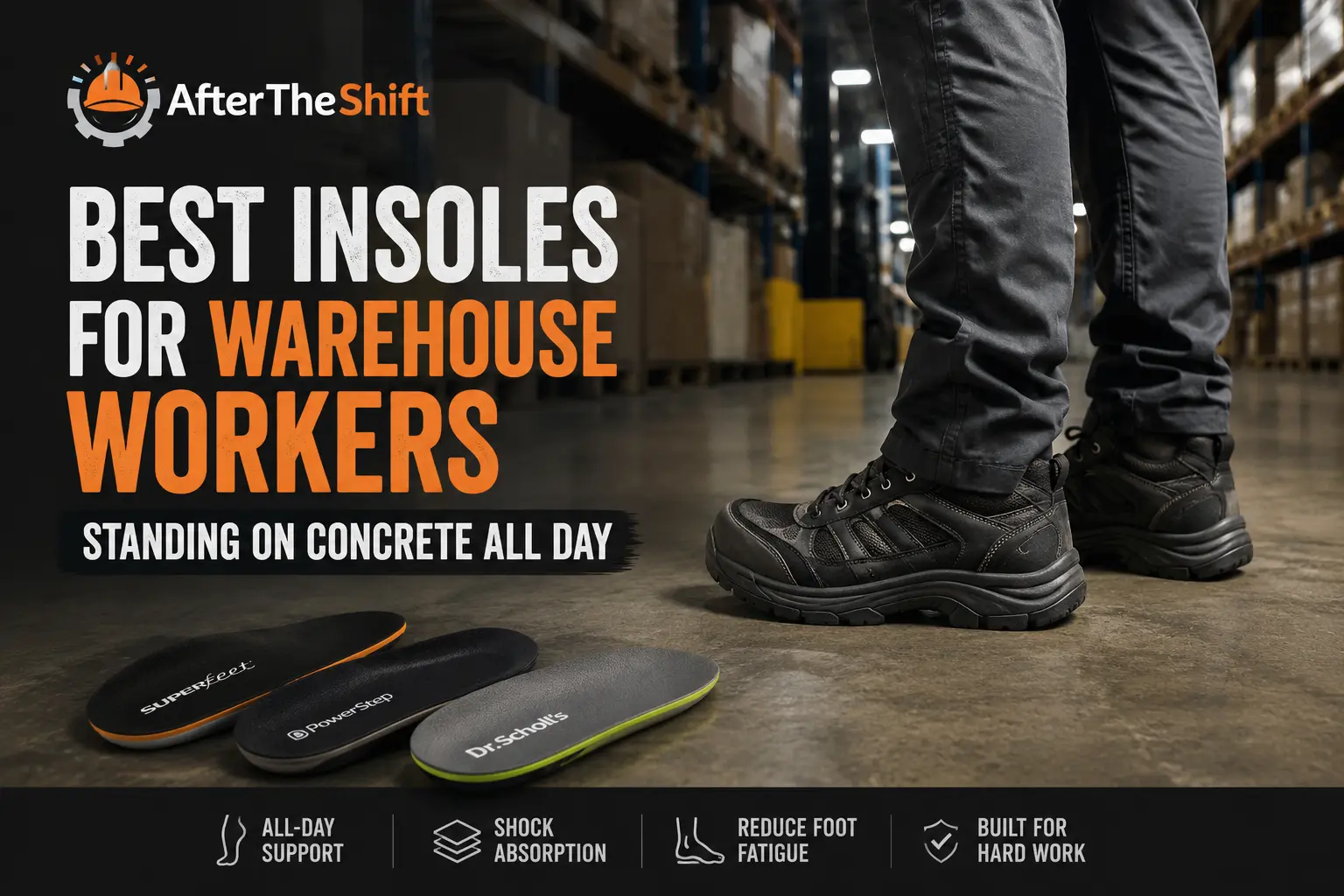
Workers spending most of the day on concrete should also check the broader standing-on-concrete workload timeline and, if footwear is part of the problem, the guide to insoles for warehouse workers standing on concrete.
Achilles Symptom → Cause → Fix Matrix
Use the pattern of pain — not pain alone — to decide whether you should modify workload, change footwear, start rehabilitation or get assessed.
| Symptom | More likely explanation | First move | Red flag? |
|---|---|---|---|
| Stiff first steps after waking, then loosens | Load-sensitive Achilles/tendinopathy pattern | Gentle movement + progressive loading | Usually no |
| Pain 2–6 cm above heel | Mid-portion Achilles involvement | Control workload and strengthen calf | Usually no |
| Pain directly where tendon meets heel | Insertional Achilles involvement | Avoid aggressive deep heel drops initially | Monitor |
| Boot collar rubs exactly over the painful point | External pressure may be aggravating symptoms | Check fit, heel counter and lacing | Usually no |
| Symptoms worsen each morning despite same workload | Recovery capacity may be falling behind load | Reduce major trigger + consider assessment | Moderate |
| Numbness or tingling | Not a classic Achilles tendinopathy symptom | Check footwear/nerve causes; seek assessment if persistent | Needs different pathway |
| Sudden snap/pop + weak push-off or inability to stand on toes | Possible rupture | Urgent medical assessment | YES |
Seek urgent assessment after an acute Achilles injury if you heard or felt a pop/snap, suddenly lost normal push-off, cannot rise onto your toes normally, cannot walk normally, or developed major bruising/swelling.
Also get urgent medical help for unexplained major calf swelling, especially with chest pain or shortness of breath.
If the pain is closer to the heel than the tendon itself, compare your pattern with heel pain that is worst after rest. If the entire ankle is taking the load, use the ankle pain after walking on concrete guide.
Interactive Achilles Pain Decision Tree
This decision tree separates acute rupture-type warning signs from gradual load-sensitive patterns before you choose a recovery strategy.
1. Did the pain start suddenly with a snap, pop, kick-like feeling or acute injury?
The 4 Practical Achilles Damage Stages for Physical Workers
Use these four stages as a workload decision tool, not as a medical grading system: the key progression is from temporary stiffness → persistent symptoms → lost function → acute injury warning signs.
Tendon conditions do not progress through four perfectly predictable biological stages. The table below is an After The Shift decision framework based on symptom behaviour and function, designed to tell workers when ordinary load management stops being enough.
| Stage | What it feels like | Load response | Recovery expectation | Action |
|---|---|---|---|---|
| 1 — Reactive stiffness | Tight after shift/rest; mild first-step soreness | Warms up and function stays normal | Often easier to reverse when addressed early | Control load + begin strength work |
| 2 — Persistent irritability | Morning stiffness recurring most days | Hard shifts create next-day flare-ups | Usually needs weeks to months of consistent rehab | Structured loading + workload modification |
| 3 — Function loss | Pain alters walking, stairs or push-off | No longer reliably “warms out” | More prolonged; assessment becomes more valuable | Reduce provocative load + physiotherapy/MSK review |
| 4 — Acute injury warning | Sudden pop/snap, weakness, bruising or inability to push off | Major immediate function change | Cannot be estimated safely without diagnosis | Urgent medical assessment |
The morning after a shift or exercise session is often more informative than how the tendon felt while it was warm. If the next morning is repeatedly much worse, the previous day's dose was probably more than your current tendon capacity tolerated well. Reduce the provoking load rather than simply adding more stretching.
10-Question Achilles Load Test
This mini-test estimates how irritable your current Achilles pattern is; it does not diagnose a tear or tendinopathy. If you had a sudden injury, pop or major loss of function, skip the quiz and use the urgent pathway above.
1. Is the Achilles stiff during your first steps after waking?
2. Does it hurt when you first walk after sitting for a while?
3. Does climbing stairs or pushing off the toes reproduce the pain?
4. Is the tendon itself tender when you gently press the painful area?
5. Have you noticed persistent local thickening or swelling around the tendon?
6. Is it clearly worse the morning after a hard shift?
7. Does the stiffness persist even after a day off?
8. Without a sudden injury, does the affected side feel clearly weaker during normal push-off than the other side?
9. Did your walking, overtime, stairs, ladders or training increase shortly before symptoms started?
10. Is the pain changing how you walk or making you avoid normal push-off?
What Actually Helps Achilles Pain Before, During and After a Shift?
The fastest useful strategy is to reduce the worst load spike without making the tendon completely inactive, then progressively rebuild the calf-Achilles system's ability to tolerate work.
- Walk for a few minutes before demanding stairs or ladders.
- Use controlled ankle movement instead of forcing a deep stretch into a cold tendon.
- Check that the boot collar is not pressing directly into the painful area.
- Use supportive footwear rather than worn-out, unstable work shoes.
- Reduce unnecessary repeated toe-standing when possible.
- Alternate tasks instead of stacking all stairs/ladders together.
- Watch for limping — it is a stronger warning than soreness alone.
- Use breaks to move gently rather than sitting until completely stiff.
- Judge the day by the next-morning response.
- Use short-term symptom relief if helpful, but do not confuse pain relief with restored capacity.
- Perform your planned calf-loading programme if symptoms permit.
- Reduce tomorrow's dose if today's load creates a major next-day flare.
1. Stop chasing the deepest possible stretch
A tight feeling makes people want to stretch harder. But “feels tight” does not prove that the tendon needs maximal stretching. If a deep calf stretch produces sharp tendon pain — especially directly at the heel insertion — back off.
2. Build calf strength gradually
Progressive heel-raise exercises are widely used to improve the ability of the calf-Achilles unit to tolerate load. An easier starting point can be seated heel raises or two-leg standing heel raises. Harder stages may progress toward single-leg and externally loaded variations once symptoms and strength permit.
A rehabilitation exercise does not always need to be completely pain-free, but pain should remain controlled and the tendon should settle afterward. If an exercise causes a large pain spike, worsening limp or clearly worse next-morning symptoms, reduce the load, range, sets or repetitions rather than forcing progression.
3. Fix the work dose, not just the after-work routine
You cannot out-recover a workload that repeatedly exceeds your current capacity. If 20 ladder climbs trigger symptoms but eight do not, temporary task modification can be more valuable than adding another recovery product at home.
For a broader recovery structure, use the physical work recovery guide or build a personalised sequence with the After The Shift routine builder.
The fastest fix is rarely complete rest or one stretch. Find the specific work exposure that produces the next-day flare, reduce that dose enough for symptoms to stabilise, then rebuild calf/Achilles capacity progressively. The goal is to return to normal load with more capacity, not permanently avoid using the tendon.
Achilles Pain Treatment Options Compared
Progressive exercise and workload management are usually the core long-term tools for gradual Achilles tendinopathy; passive treatments are better treated as support rather than the entire plan.
| Treatment | Best for | Skip / reconsider if | Typical cost |
|---|---|---|---|
| Workload modification | Clear work-triggered flare-ups | Do not use as permanent total rest | Free |
| Progressive heel-raise loading | Building long-term calf/tendon capacity | Acute rupture suspected or exercise causes major deterioration | Free–low |
| Supportive footwear / heel lift | Short-term reduction of tendon strain or poor footwear | If it becomes a substitute for restoring strength | Low–moderate |
| Ice / short-term pain relief | Temporary symptom control after an irritating day | If you are using pain relief to mask a worsening workload problem | Low |
| Physiotherapy | Persistent symptoms, uncertainty or progression planning | No major downside when appropriately assessed | Varies by health system |
| Shockwave / specialist options | Selected persistent cases after appropriate rehabilitation | Early uncomplicated symptoms before basic loading has been tried | Moderate–high |
| Surgery | Selected tears or difficult cases after specialist assessment | Routine early treatment of ordinary gradual tendinopathy | High / health-system dependent |
Pain relief can make a shift feel easier without increasing tendon capacity. If medication, ice or a heel lift lets you do more work but the tendon is increasingly stiff the following morning, the underlying workload problem has not necessarily improved.
How long should improvement take?
Do not judge a tendon rehabilitation plan after three days. Many structured Achilles programmes are performed for roughly 12 weeks or longer, while full return to unrestricted pain-free activity can take several months. Progress is usually better judged by trends in morning stiffness, walking tolerance, heel-raise strength and next-day response than by expecting instant zero pain.
If symptoms are not showing a useful trend after several weeks of sensible load modification and progressive exercise — or they are getting worse — get assessed rather than repeatedly changing random exercises.
Achilles Shift Recovery Checklist
Use this checklist to control the variables that most often determine whether tomorrow morning is better or worse.
Bottom Line: What Should You Do Tomorrow?
If your Achilles is gradually stiff after long shifts but still functions normally, reduce the biggest aggravating workload spike and start rebuilding calf-Achilles capacity progressively.
- Best first move: identify what makes the next morning worse.
- Best long-term move: progressive calf/Achilles strengthening.
- Best footwear move: remove pressure from the painful area and replace clearly worn-out support.
- Avoid: aggressive stretching into sharp insertion pain or using pain relief to push through a worsening limp.
- Get help: when symptoms persist, function falls, or an acute injury produces rupture-type warning signs.
Achilles recovery is usually measured in trends, not overnight cures. A useful trend is less morning stiffness, better walking tolerance, improving calf strength and fewer next-day flare-ups. Full recovery from established tendinopathy can take months even when the plan is working.
Achilles Tendon Pain After Work: FAQs
These answers cover the most common search questions about Achilles stiffness after standing, walking and physical work.
Related Guides for Foot, Ankle and Calf Pain After Work
If Achilles pain is only one part of the problem, use the symptom location to continue down the right path instead of treating the whole lower leg the same way.
- Ankle pain after walking on concrete all day — what is taking the load?
- Calf pain after standing all day — fatigue, circulation or something else?
- Heel pain from standing all day — why the first steps after rest hurt most
- Work pain vs injury — how to tell when the pattern has changed
- The physical work recovery guide for building a complete recovery plan
Next Steps
Do these in order so you are solving the load problem instead of collecting random treatments.
- Classify the pattern: gradual stiffness vs acute injury.
- Find the trigger: walking volume, stairs, ladders, toe-standing, footwear pressure or a recent increase in hours.
- Reduce the trigger enough to stabilise symptoms without making the leg completely inactive.
- Build capacity: use progressive calf/Achilles loading appropriate to your symptom location and level.
- Check the next morning: better, same or worse?
- Progress only when the trend allows it.
- Escalate: use GP, physiotherapy or MSK assessment if function drops, symptoms persist or you are unsure what structure is actually causing the pain.
If your problem is not just the Achilles, use the After The Shift Routine Builder to organise your before-work, during-shift and after-work recovery instead of adding isolated fixes one at a time.
Save this before your next long shift.
Bookmark this guide and compare your Achilles again tomorrow morning — the 24-hour response tells you more than how it feels while it is warmed up at work.
This article is general recovery education, not a diagnosis or a substitute for care from a qualified clinician. Stop and get medical help for severe pain, numbness, weakness, chest pain, sudden swelling, fever, or symptoms that keep worsening.
Log in to leave a comment.