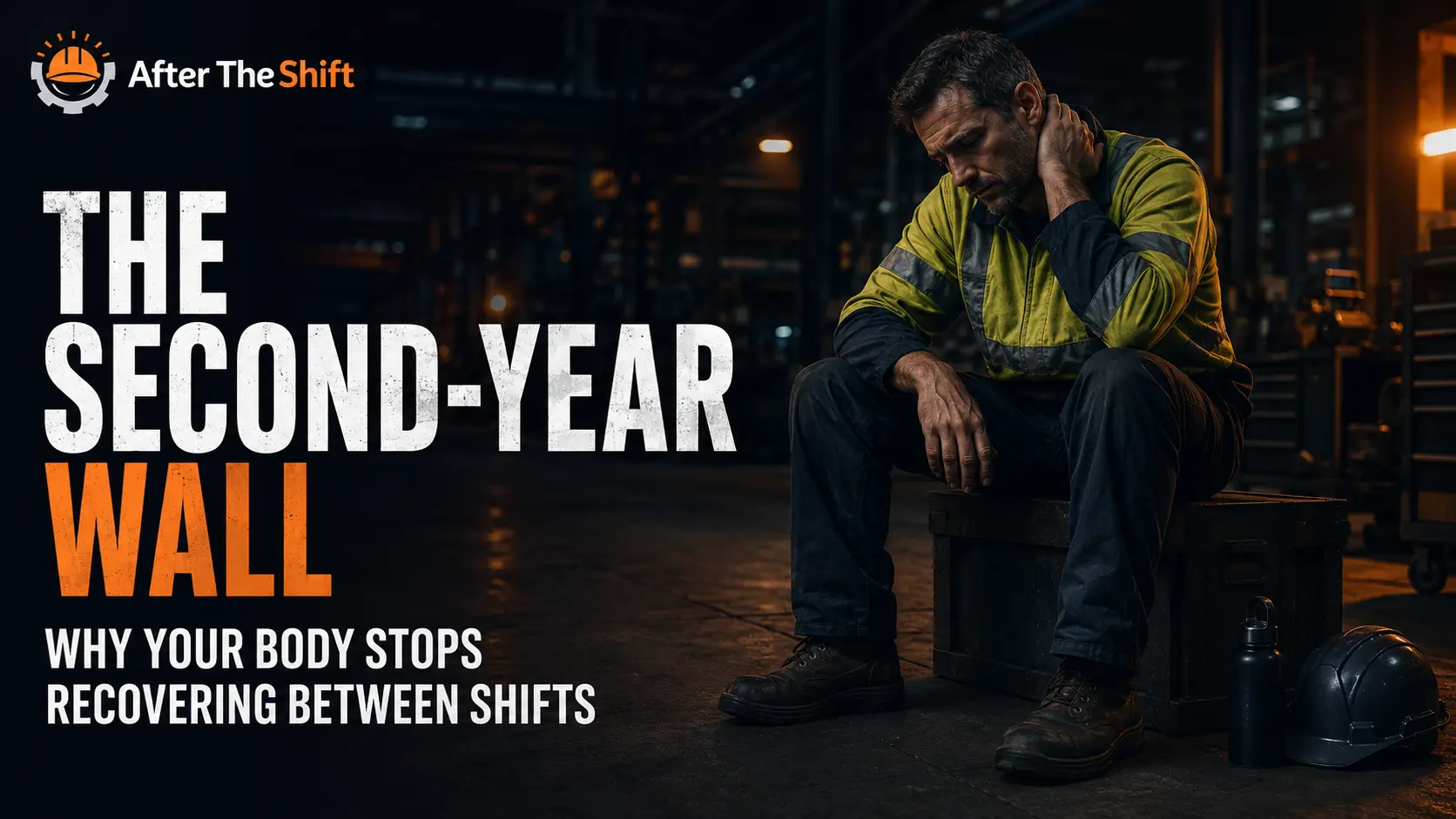
When soreness lasts longer and every shift starts heavier, use this recovery test to find what is accumulating—and stop it before fatigue becomes injury.
The second-year wall is the point where soreness, stiffness, poor sleep, and heavy mornings stop disappearing before the next shift. It commonly affects warehouse, construction, delivery, production, cleaning, and other physical workers whose daily workload has stayed high while their recovery margin has gradually shrunk.
Your body has probably not suddenly become weak. Repeated shifts are now using more recovery than your sleep, food, movement, and time off can replace.
- Track morning symptoms for seven days.
- Reduce the task that triggers symptoms fastest.
- Eat, hydrate, and move lightly after shifts.
- Act when recovery slows—not only when pain becomes severe.
- Trying to erase accumulated fatigue in one weekend.
- Adding hard workouts to already overloaded body parts.
- Using caffeine to cover worsening recovery.
- Working through weakness, spreading numbness, or swelling.
If the same workload now takes more than one night to recover from, treat it as accumulated load—not as something you should keep pushing through until your body forces you to stop.
Fast answer for busy workers: The “second-year wall” is not a medical diagnosis or a deadline that arrives exactly after 24 months. It describes a common pattern: repeated physical work stops feeling temporary because fatigue carries into the next shift. The first fix is a seven-day recovery reset combined with less exposure to the task that causes symptoms fastest. Sharp pain, weakness, numbness, major swelling, chest symptoms, or unexplained exhaustion require medical advice instead.
| If you… | Likely pattern | Flag | Do first |
|---|---|---|---|
| Recover after one good night | Normal short-term fatigue | Low | Keep your routine consistent. |
| Need the whole weekend to feel normal | Recovery capacity is narrowing | Moderate | Run the seven-day reset below. |
| Start each shift sore from the last one | Accumulated physical load | High | Reduce the main aggravating task. |
| Have numbness, weakness, or one-sided swelling | Possible injury or medical issue | High | Stop self-testing and seek medical advice. |
- Why recovery changes after repeated shifts
- What this applies to—and what it does not
- How job type changes the risk
- Symptom, cause, and first-fix matrix
- Interactive decision tree
- The four accumulation stages
- Ten-question recovery test
- What actually fixes it
- Recovery options and products compared
- Frequently asked questions
Why Does Your Body Stop Bouncing Back From Shifts?
Your body stops bouncing back when repeated workload consistently exceeds the recovery available between shifts. The calendar is not the cause. “Second year” simply describes the period when small recovery gaps may become noticeable after hundreds of similar shifts.
Early in a physical job, a new worker may have fewer old irritations, more enthusiasm, lighter duties, or more variation while learning. Later, the same worker may receive heavier tasks, move faster, skip breaks, sleep less, or repeat the same motion thousands of additional times.
The second-year wall happens when each shift leaves a small amount of unrecovered fatigue behind. One shift may not cause a clear injury, but repeated lifting, gripping, standing, bending, vibration, night work, and missed recovery can gradually shorten the distance between “tired” and “already sore before work.”
| Load source | What accumulates | Early sign | Decision criterion |
|---|---|---|---|
| Repeated lifting | Back, shoulder, and grip fatigue | Technique changes late in the shift | Pain begins earlier each week |
| Standing or walking | Foot and leg irritation | Heavy first steps after sitting | Morning foot pain lasts longer |
| Scanning or assembly | Wrist, elbow, and shoulder load | Grip feels slower or clumsier | Symptoms persist on days off |
| Poor-quality sleep | Incomplete whole-body recovery | Wake unrefreshed after enough time in bed | Three or more poor mornings weekly |
| Under-eating or dehydration | Low energy and poor work tolerance | Energy improves after food and water | Meals are regularly missed during hard shifts |
If this pattern already sounds familiar, compare it with the signs of accumulated fatigue workers often miss.
What This Applies To—and What It Does Not
This guide applies to a gradual loss of recovery capacity that clearly follows repeated physical or shift work. It is for workers who once recovered overnight but now carry stiffness, heaviness, soreness, or low energy into the next workday.
This usually applies to
- Symptoms that build across consecutive shifts.
- Stiffness that improves after easy movement.
- Soreness connected to a specific repeated task.
- Days off spent recovering rather than living.
This does not explain
- Sudden severe pain after an accident.
- Unexplained fatigue unrelated to workload.
- Chest pain, fainting, or breathing difficulty.
- Progressive weakness or spreading numbness.
Seek urgent medical care for chest pain, breathing trouble, fainting, sudden one-sided weakness, a major injury, or severe symptoms that feel dangerous. Arrange medical advice for persistent numbness, worsening weakness, significant swelling, fever, unexplained exhaustion, or pain that repeatedly wakes you and does not improve.
Which Jobs Make the Second-Year Wall More Likely?
The highest-risk job is not necessarily the heaviest one; it is the job that repeats the same load faster than the worker can recover from it. Task repetition, awkward position, pace, surface, vibration, shift timing, and control over breaks all change the recommendation.
| Job type | Main load angle | Risk pattern | Compounding factor | Best first change |
|---|---|---|---|---|
| Warehouse picker | Walking, lifting, reaching | Feet, knees, back | Concrete and targets | Reduce unnecessary carries and rotate reach height |
| Construction worker | Carrying, kneeling, overhead work | Back, knees, shoulders | Weather and unstable surfaces | Use mechanical help and rotate positions |
| Delivery driver | Sitting followed by lifting | Back, hips, shoulders | No warm-up between stops | Move before the first heavy unload |
| Assembly or packing | High repetition, fixed reach | Wrist, neck, elbow | Low movement variation | Alternate hand, stance, or task where possible |
| Cleaner | Pushing, bending, twisting | Back and shoulders | Poor tool height | Adjust handle length and switch sides |
| Night-shift worker | Physical load plus circadian disruption | Whole-body fatigue | Daytime light and noise | Protect a consistent dark sleep window |
Symptom → Cause → First-Fix Matrix
The fastest way to respond is to match the symptom pattern—not just the painful body part—to its most likely recovery gap. This matrix does not diagnose injuries; it helps decide the safest first action.
| Symptom | Likely contributor | First fix | Recheck after | Red flag |
|---|---|---|---|---|
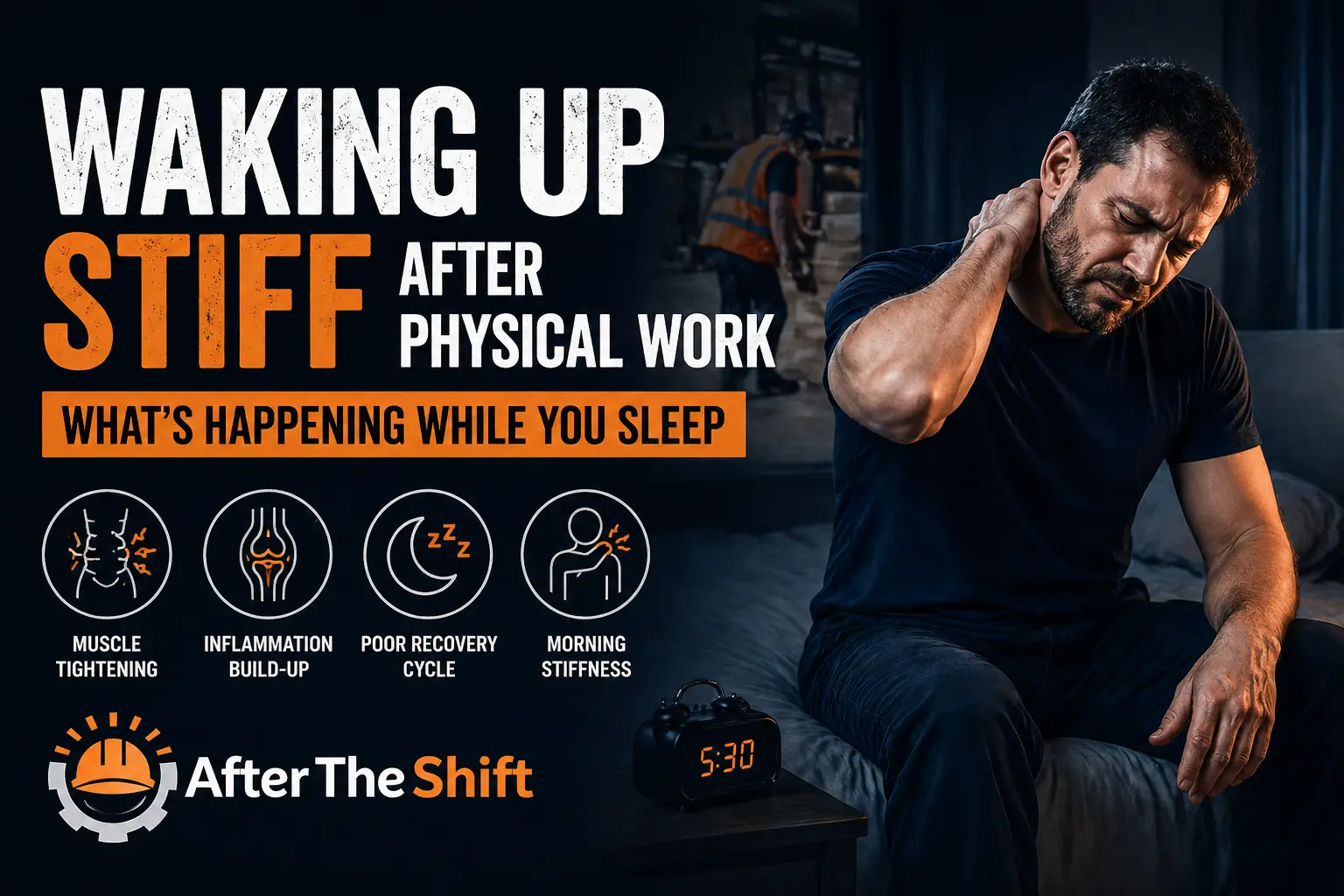
| “I wake up heavy and slow.” | Accumulated load, poor fuel, poor sleep quality | Seven-day food, hydration, and sleep reset | 7 days | Unexplained severe weakness |
| “My back unlocks after moving.” | Repeated bending plus post-shift immobility | Easy movement and fewer end-range bends | 3–7 days | Leg weakness or bladder/bowel changes |
| “My feet hurt on the first steps.” | Standing volume, surface, footwear | Review footwear and reduce continuous standing | 1–2 weeks | Hot, red, or severely swollen foot |
| “My hands go numb at night.” | Grip load or compressed wrist/elbow position | Neutral sleep position and less forceful gripping | Several nights | Persistent numbness or weak grip |
| “Pain starts earlier every shift.” | Recovery debt is increasing | Reduce the aggravating task now | Next 3 shifts | Sharp or rapidly worsening pain |
| “My day off feels worse.” | Delayed fatigue plus routine collapse | Keep wake time, food, and light movement stable | 2–3 days off | Fatigue unrelated to work |
Do not judge recovery only by pain intensity. A more useful early warning is timing: symptoms start earlier in the shift, last longer afterward, require more caffeine or rest, or change how you lift, walk, grip, or reach.
Decision Tree: What Should You Do About Slower Recovery?
Start with red flags, then decide whether your main problem is pain, whole-body fatigue, or poor sleep. Choose the answer that best matches today—not your best day last month.
Do you have chest symptoms, fainting, sudden weakness, major swelling, spreading numbness, or severe unusual pain?
The Four Accumulation Stages
The second-year wall usually develops through a change in recovery time, symptom timing, work performance, and finally function. Acting during Stages 1 or 2 is easier than waiting for Stage 4.
| Stage | How it feels | What is changing | Recovery | Action |
|---|---|---|---|---|
| 1: Normal load | Tired after work, normal by morning | Temporary fatigue | One good night | Maintain your routine |
| 2: Recovery lag | Morning stiffness, heavy starts | Some fatigue carries forward | More than one night | Run the seven-day reset |
| 3: Accumulated overload | Pain starts earlier; work feels heavier | Performance or movement changes | Days off are insufficient | Reduce exposure and consider assessment |
| 4: Function affected | Weakness, persistent numbness, major limitation | Possible injury or medical problem | Not responding normally | Get professional help |
If symptoms improve after one or two easier days and do not change your movement, the pattern is more likely manageable fatigue. If symptoms begin earlier, last longer, or alter how you work across several weeks, the recommendation changes to workload reduction and possible assessment.
Mini-Test: Have You Hit the Second-Year Wall?
This ten-question screen measures recovery warning signs, not injury severity. Answer according to the last two weeks. One point is added for every “Yes.”
1. Do you begin shifts with soreness left from the previous one?
2. Does stiffness regularly last more than 30–60 minutes after waking?
3. Does pain or heaviness begin earlier in the shift than it used to?
4. Do you spend most of your days off trying to feel normal again?
5. Have you changed how you lift, grip, reach, walk, or stand because of symptoms?
6. Do you need more caffeine than before to start or finish shifts?
7. Does work-related discomfort interrupt your sleep?
8. Do you regularly skip proper meals or hydration during hard shifts?
9. Do symptoms keep returning after short periods of improvement?
10. Are you noticeably less capable at the end of an ordinary shift?
What Actually Fixes the Second-Year Wall?
The most effective fix combines lower exposure to the main aggravating task with a repeatable recovery routine before, during, and after work. Buying equipment cannot compensate for a workload that keeps escalating, but the right products can remove practical barriers to hydration, food, foot comfort, and daytime sleep.
Before the shift
- Check whether yesterday’s symptoms remain.
- Eat before heavy work begins.
- Hydrate before you are thirsty.
- Warm up the stiffest area for 3–5 minutes.
During the shift
- Change stance, hand, reach, or task where possible.
- Use equipment instead of proving strength.
- Drink and eat before energy collapses.
- Notice when symptoms first appear.
After the shift
- Eat a real meal with protein and carbohydrates.
- Use 8–12 minutes of easy movement.
- Stop caffeine early enough to protect sleep.
- Record symptoms before they fade from memory.
For seven days, keep four anchors consistent: a real post-shift meal, accessible water, 8–12 minutes of easy movement, and a protected sleep window. At the same time, reduce the work movement that makes symptoms appear fastest. Judge the plan by morning recovery and symptom timing—not motivation.
If eight hours in bed still leaves you crushed, use the deeper guide to why sleep length alone does not fix physical work fatigue. If lying down makes the problem worse, check whether your sleep position is reloading the same painful area.
Recovery Options and Products Compared
Use products to make good recovery easier—not to disguise symptoms or claim that an accessory treats an injury. The best purchase solves a barrier you actually have; the best overall intervention is still controlling workload.
Affiliate disclosure: This article contains affiliate links. If you purchase through them, After the Shift may earn a commission at no additional cost to you.
| Option | Best for | Who should skip | Cost | Verdict |
|---|---|---|---|---|
| Hydro Flask 32 oz insulated bottle | Workers who forget to drink when water is not nearby | Anyone who already carries a reliable bottle | Moderate one-time cost | Best practical daily pick |
| Rubbermaid Brilliance meal-prep containers | Workers skipping meals or relying on vending food | Anyone who already packs meals consistently | Low-to-moderate | Best budget system fix |
| Manta Original Sleep Mask | Night workers and daytime sleepers fighting room light | Workers whose main problem is pain rather than light | Moderate | Best sleep upgrade |
| Shiatsu foot massager with heat and air compression | Post-shift comfort after long standing or walking | People with unexplained swelling, numbness, circulation concerns, acute injury, or medical restrictions | Higher | Comfort upgrade—not treatment |
| Workload or task change | Symptoms caused by one repeated work exposure | Not applicable—adjust to what is realistically controllable | May require employer cooperation | Highest-impact option |
Buy only when the product removes a specific obstacle: no water nearby, no prepared meals, daylight entering your sleep room, or tired feet that benefit from ordinary comfort. Skip the purchase if you expect it to cure persistent pain, numbness, weakness, swelling, or a workload problem.
Seven-Day Second-Year-Wall Checklist
Complete this checklist for seven consecutive days before deciding whether your recovery routine is working. Stop the experiment and seek appropriate help if red-flag symptoms appear.
Bottom Line
The second-year wall means your recovery margin has narrowed—not that physical breakdown is inevitable. Act on the earliest measurable changes: symptoms starting sooner, lasting into the next shift, requiring more recovery time, or changing how you perform the job.
The best first response to slower shift recovery is a seven-day reset combined with less exposure to the task that causes symptoms fastest. Protect food, hydration, light post-shift movement, and sleep quality. If symptoms still worsen—or include weakness, numbness, swelling, or loss of function—stop treating the problem as ordinary fatigue and get assessed.
- Best choice: load control plus a consistent seven-day recovery routine.
- Best for: workers whose symptoms build across repeated shifts.
- Who should avoid self-testing: workers with red-flag symptoms or a major recent injury.
- What changes the recommendation: symptoms that alter movement, persist during time off, or fail to improve when workload drops.
Frequently Asked Questions
These answers separate ordinary short-term tiredness from a recovery problem that deserves action. The questions use the same wording workers commonly use when searching for help.
Related Recovery Guides
Choose the next guide according to the part of the pattern that affects you most.
- Browse the physical-work recovery hub
- Recognize accumulated fatigue before it becomes obvious
- Learn the difference between resting and actively recovering
- Find out why eight hours of sleep may still leave you exhausted
- Fix sleep positions that reload work-related pain
- Use the three-anchor rule when days off feel worse
- Build a longer-term plan for lasting in physical work
Next Steps
Do not change ten things randomly; route yourself according to the strongest signal.
- Take the mini-test and record your current tier.
- Name the main trigger: the task that makes symptoms appear fastest.
- Run the checklist for seven days while reducing that trigger where possible.
- Compare morning recovery: are symptoms lighter, shorter, or starting later?
- If there is no improvement, reassess workload and consider professional advice.
- If red flags appear, stop the recovery experiment and seek appropriate medical help.
Start your seven-day reset before another month disappears.
Use the checklist after every shift, then continue with the long-term guide to lasting in a physical job.
Save this before your next shift.
One difficult morning can mislead you. A seven-day pattern shows whether your body is recovering—or merely surviving until the next day off.
This article is general recovery education, not a diagnosis or a substitute for care from a qualified clinician. Stop and get medical help for severe pain, numbness, weakness, chest pain, sudden swelling, fever, or symptoms that keep worsening.

Log in to leave a comment.