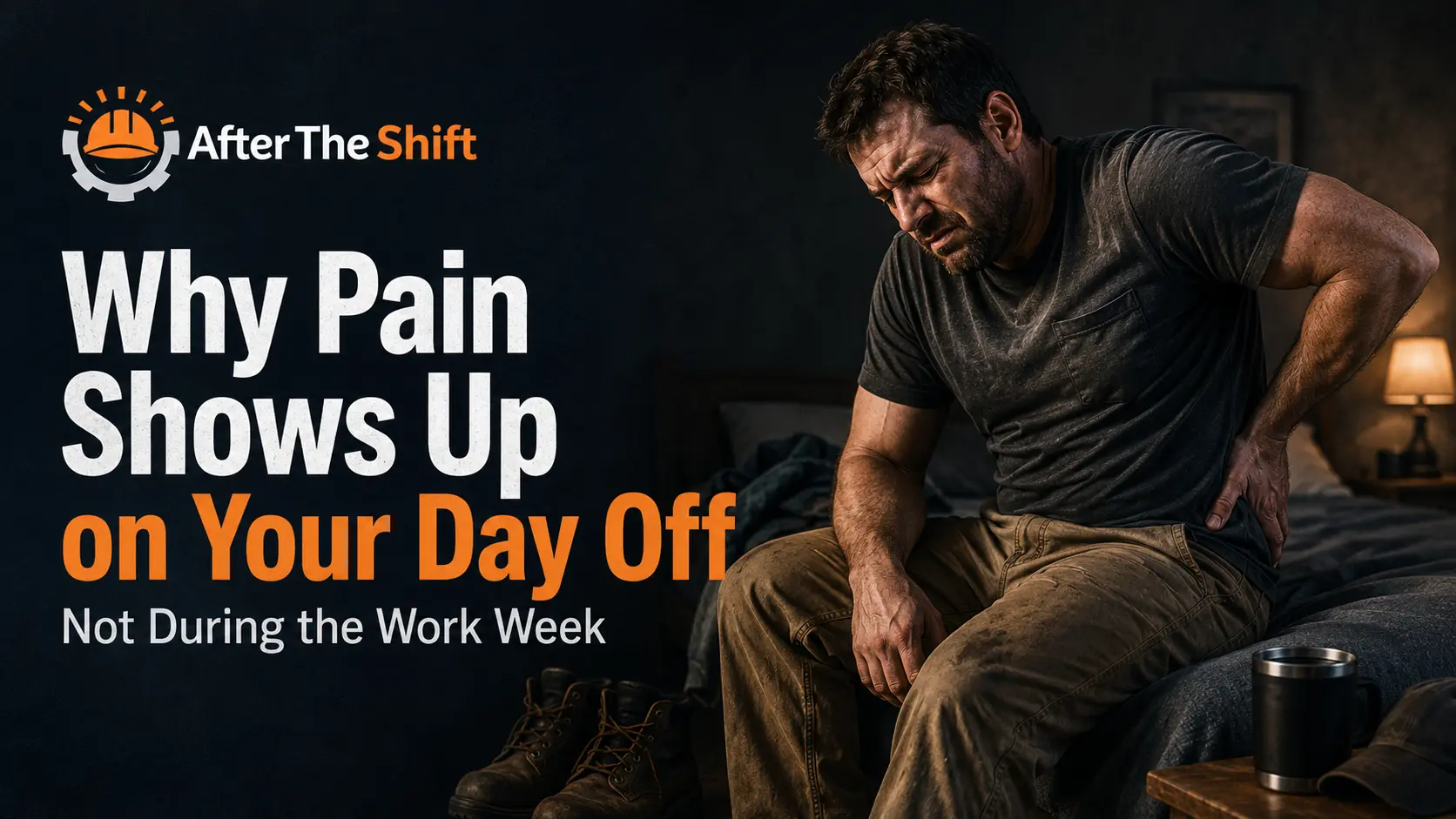
Your body can hide pain while you work, then dump the bill on your day off — here is how to tell recovery soreness from a warning sign.
Pain often shows up on your day off because work keeps your body switched on, distracted, warm, and full of stress hormones. When the shift pressure drops, inflammation, stiffness, nerve irritation, and accumulated fatigue become easier to feel. This is common in warehouse, construction, delivery, packaging, assembly, and tool-heavy jobs.
If pain is worse on your day off but improves after gentle movement, it is usually delayed recovery pain from accumulated workload. If pain is sharp, spreading, numb, swollen, or still getting worse after 48–72 hours, treat it as a warning sign, not normal soreness.
✓ Do
- Do a 10–20 minute easy walk on your day off.
- Use gentle mobility before heavy stretching.
- Track whether pain improves after movement.
- Reduce the worst work position next shift.
✗ Avoid
- Do not stay completely still all day.
- Do not stretch sharp pain aggressively.
- Do not ignore numbness, weakness, or swelling.
- Do not call recurring weekend pain “just age.”
If pain improves after gentle movement, recover actively; if pain gets worse with normal movement or comes with nerve symptoms, stop guessing and get checked.
Fast answer for busy readers: day-off pain usually happens because the work week creates small tissue irritation faster than your body can clear it. During work, heat, adrenaline, repetition, and focus can hide the signal. On your day off, movement drops, joints cool down, muscles stiffen, inflammation becomes louder, and your nervous system finally notices what has been building up.
| If you… | Most likely meaning | Risk/flag | Best first move |
|---|---|---|---|
| Feel stiff after sleeping in | Cooling down + low movement | Low | Walk, shower, light mobility |
| Hurt more Sunday than Friday | Delayed inflammation from the week | Moderate | Active recovery + reduce load next week |
| Get numbness, tingling, or weakness | Possible nerve irritation | High | Stop provoking it and get assessed |
| Have swelling, heat, or sharp pain | Irritated tissue or injury | High | Reduce load, monitor, medical help if worsening |
This usually applies to workers who feel worse after the work week but can still walk, move, and function. This does not apply to major falls, crushing injuries, sudden severe pain, chest pain, unexplained shortness of breath, loss of bladder or bowel control, or rapidly worsening weakness.
Why pain shows up on your day off
Day-off pain happens when your body stops masking the workload from the week. During a shift, movement keeps tissues warm, pressure keeps you focused, and stress hormones can reduce how strongly you notice pain. Once you stop, the same irritated tissues become louder.
The common mistake is thinking pain only counts if it appears while lifting, drilling, scanning, walking, or kneeling. Physical work often creates a delayed signal. Your body can finish the shift first and complain later.
Pain that appears on a day off is often delayed workload pain. It is more likely when the work week includes repetitive bending, gripping, standing, kneeling, lifting, driving, or overhead work. The pain becomes noticeable when the body cools down, movement drops, and accumulated irritation is no longer hidden by work pressure.
| Mechanism | What happens during the week | Why it hurts on the day off | What helps first |
|---|---|---|---|
| Accumulated fatigue | Small loads repeat hundreds of times | Recovery falls behind damage | Reduce repeat positions |
| Inflammation | Tendons, joints, or fascia get irritated | Rest makes swelling and stiffness obvious | Gentle movement, load control |
| Nervous system sensitivity | Pain signals are muted by focus | Quiet time makes signals louder | Sleep rhythm, easy movement |
| Cooling down | Muscles stay warm from work | Joints feel locked after stillness | Heat, walk, light mobility |
How job type changes the pain pattern
Your job decides where day-off pain usually appears. The body part that hurts on Saturday or Sunday is often the body part that was loaded quietly all week.
| Job type | Main angle/load | Common day-off pain | Compounding factor |
|---|---|---|---|
| Warehouse picking | Reach, scan, twist, lift | Wrist, shoulder, lower back | Repetition beats weight |
| Construction | Kneel, drill, carry, overhead reach | Knees, shoulders, elbows, back | Awkward positions stack fast |
| Delivery driving | Sit, twist, lift, climb | Hips, back, knees, feet | Loading hurts more than driving |
| Assembly line | Same motion all day | Hands, forearms, neck, shoulders | Low force still adds up |
| Forklift operation | Sit, twist neck, brace spine | Lower back, neck, hips | Sitting still hides load |
For deeper job-specific patterns, use the guides on delivery driver body pain from loading and unloading, assembly line injuries from repeated motion, and forklift operator back pain from sitting and twisting.
Symptom → cause → fix matrix
The fix depends on the type of pain, not just the location. Stiffness, soreness, sharp pain, swelling, numbness, and weakness do not mean the same thing.
| Symptom you feel | Likely cause | Fastest useful fix | Red flag |
|---|---|---|---|
| Whole body aches | General fatigue and low recovery | Food, hydration, walk, sleep timing | Low if improving |
| Morning stiffness | Stillness after loaded week | Heat + 10 minutes easy movement | Moderate if lasting hours |
| Sharp joint pain | Irritated joint or tendon | Avoid the painful angle | High if worsening |
| Tingling or numbness | Nerve irritation or compression | Stop compression positions | High |
| Swelling or heat | Active irritation | Reduce load, monitor, elevate if useful | High if spreading |
Get medical help quickly if pain follows a fall, comes with major swelling, numbness, weakness, fever, chest symptoms, loss of control, or pain that is severe at rest. This article is for workload-related pain patterns, not emergency diagnosis.
Decision tree: soreness or warning sign?
Use this decision tree when pain is worse on your day off and you are unsure whether to rest, move, or get help. The main criteria are nerve symptoms, swelling, pain behavior, and whether gentle movement improves it.
Step 1: Do you have numbness, tingling, weakness, major swelling, heat, or sharp pain at rest?
The 4 damage stages
Day-off pain gets more serious when it moves from occasional stiffness to repeatable symptoms. The key threshold is not pain level alone. It is frequency, recovery time, and whether normal movement still helps.
| Stage | How it feels | What is likely happening | Recovery time | Action |
|---|---|---|---|---|
| Stage 1 | Stiff but warms up | Normal fatigue | Same day | Active recovery |
| Stage 2 | Sore all day off | Recovery lag | 24–48 hours | Reduce weekly load |
| Stage 3 | Pain repeats every weekend | Tendon, joint, or nerve irritation | Several days | Change work mechanics |
| Stage 4 | Pain during work and rest | Possible injury pattern | Not clearing | Get assessed |
Do not judge day-off pain only by pain level. A 4/10 pain that returns every weekend is often more useful information than one 7/10 soreness episode after an unusually hard shift.
Mini-test: how serious is your day-off pain?
This score ranks your pain by behavior, not toughness. Add one point for each “yes.” Higher scores mean your recovery plan needs more than resting on Sunday.
Answer all 10 questions:
1. Does pain show up mostly when you finally stop moving?
2. Does it repeat on most days off?
3. Does it take longer than 24 hours to calm down?
4. Does the same joint or side hurt every time?
5. Does gentle movement fail to improve it?
6. Do you feel numbness, tingling, or weakness?
7. Is there swelling, heat, or visible change?
8. Does pain affect sleep on your day off?
9. Do you need painkillers just to feel normal?
10. Is the pain starting earlier each week?
What actually fixes it — by phase
The best fix is not one magic stretch. It is controlling the load before work, during work, and after work. Day-off pain is usually built during the week, so the fix must start before your day off.
Before work
- Eat enough before heavy shifts.
- Warm the painful area lightly.
- Plan tool placement before rushing.
- Use knee pads, gloves, or better footwear when needed.
During work
- Change grip before your hand burns out.
- Alternate sides when possible.
- Break the bend-reach-twist pattern.
- Do not let one joint take every repetition.
After work/day off
- Walk before lying down all day.
- Use gentle mobility, not pain-forcing stretches.
- Keep sleep/wake time close to normal.
- Track what pain does after 48–72 hours.
The best first fix for day-off pain is a low-effort active recovery routine: 10–20 minutes walking, gentle joint movement, enough food, hydration, and avoiding the exact work position that triggered the pain. Complete bed rest often makes stiffness louder unless the pain is acute or severe.
For the bigger recovery system, use the physical work recovery guide. If sleep is not fixing the problem, compare this with why 8 hours of sleep does not fix physical work fatigue.
Treatment options compared
Choose treatment by what the pain is doing. The wrong option is usually the one that feels productive but keeps irritating the same tissue.
| Treatment | Best for | Skip if | Cost/time |
|---|---|---|---|
| Walking | Stiffness, whole-body soreness | Walking increases sharp pain | Free, 10–20 min |
| Gentle mobility | Locked hips, shoulders, back | Numbness or sharp joint pain | Free, 5–10 min |
| Heat | Cold stiffness and tight muscles | Area is swollen or hot | Low cost, 10–20 min |
| Cold/ice | Recent irritation or swelling | It makes you stiffer and worse | Low cost, short use |
| Massage/foam rolling | Muscle tightness around the painful area | Direct pressure causes nerve symptoms | Free to moderate |
| Professional assessment | Repeated, worsening, or nerve-like pain | Not needed for one mild improving ache | Higher cost, highest clarity |
Day-off recovery checklist
Use this checklist on the first morning of your day off. It prevents the common pattern where you lie still for six hours, get stiffer, then think your body is broken.
Bottom line
Pain on your day off is usually a delayed signal from the work week, not proof that rest is bad. The best choice is active recovery if the pain warms up and improves. Avoid forcing stretches, ignoring nerve symptoms, or repeating the same work position every week without changing anything.
If your day-off pain improves within 24–48 hours and feels better after movement, build an active recovery routine. If it repeats for several weekends, starts earlier each week, or includes swelling, numbness, weakness, or sharp pain, the work load needs to change and the area may need assessment.
FAQs
These answers cover the most common day-off pain questions from physical workers. Use them as rules of thumb, not a replacement for medical care when symptoms are severe or unusual.
Related links
Use these next if your pain pattern matches a specific body area or work setup.
- Why days off feel worse than workdays
- Accumulated fatigue from physical work
- Work pain vs injury warning signs
- Lower back stiffness in the morning after physical work
- Waking up stiff after physical work
- Why most recovery advice fails physical workers
Next steps
Do not just wait for next weekend to see if it happens again. Use the pain pattern to change one thing before the next shift cycle.
- If pain improves with movement, build a 20-minute active recovery routine for every day off.
- If pain repeats in the same area, identify the repeated work position causing it.
- If the problem is fatigue, start with the physical work recovery guide.
- If the problem feels like injury, compare symptoms with work pain vs injury warning signs.
- If pain includes numbness, weakness, major swelling, or sharp pain at rest, stop using internet guessing as the main plan and get assessed.
Save this checklist and run it the next morning you wake up sore on a day off. The goal is not to be tougher. The goal is to find the exact work pattern your body is finally reporting.
Bookmark this page before your next day off.
Use the decision tree, quiz, and checklist when pain shows up again so you can tell normal delayed soreness from a warning sign.
This article is general recovery education, not a diagnosis or a substitute for care from a qualified clinician. Stop and get medical help for severe pain, numbness, weakness, chest pain, sudden swelling, fever, or symptoms that keep worsening.


Log in to leave a comment.