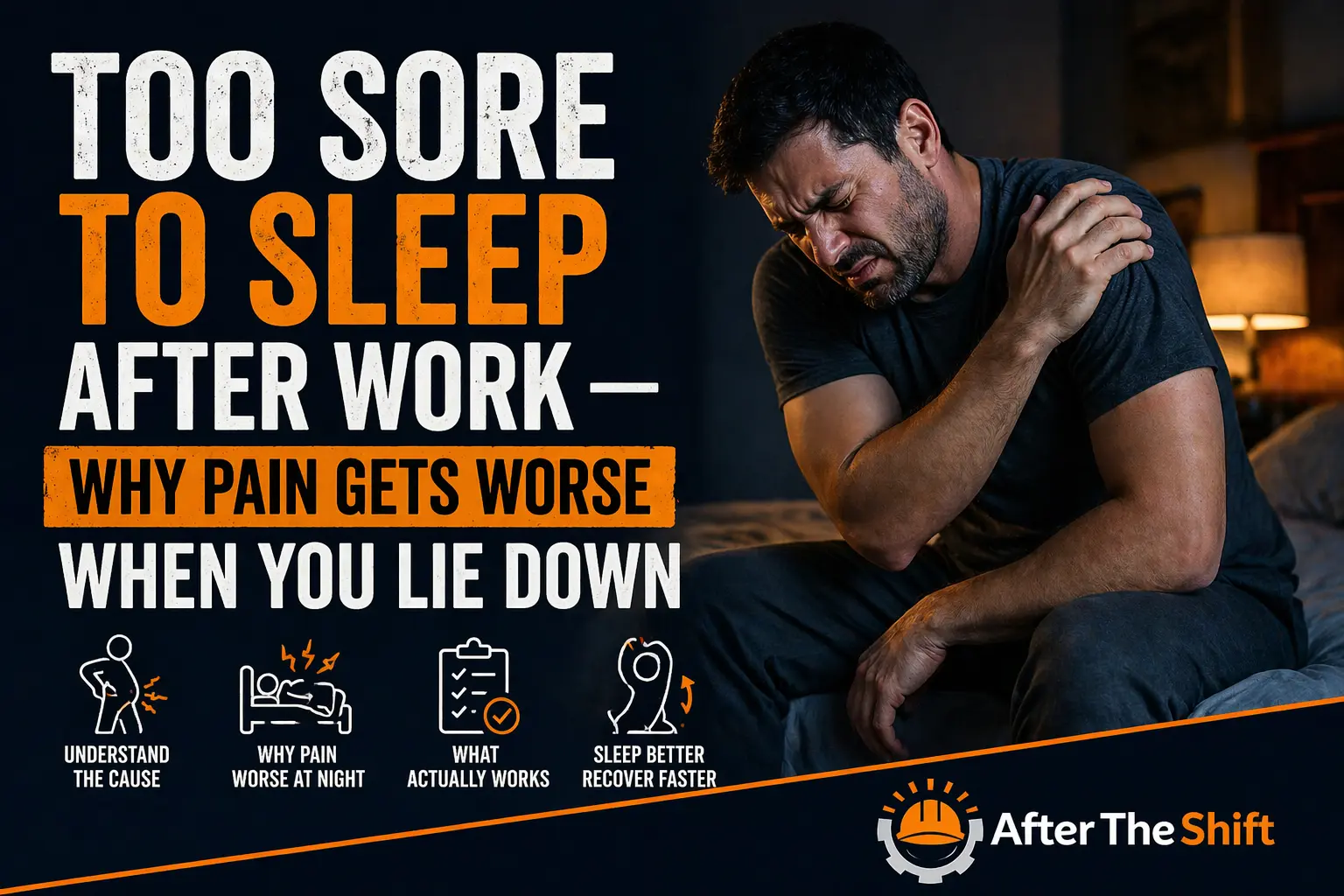
When your body finally stops moving, hidden inflammation, stiffness, and nerve irritation get louder — this shows you what kind of pain you have and what to do tonight.
If you feel more pain when you finally lie down after work, it usually means your body was being held together by movement, heat, and distraction during the shift. Once you stop, stiffness settles in, irritated tissues swell slightly, and compressed joints or nerves have nowhere to hide. The fastest fix is matching the pain pattern to the right response: soreness needs unloading and circulation, sharp joint pain needs position changes, and nerve-like pain needs you to stop forcing one sleeping posture.
This article is for physical workers whose pain gets worse at bedtime after warehouse, construction, packaging, assembly, delivery, or tool-heavy work. This usually applies to overuse soreness, irritated joints, tendon overload, and posture-related nerve pain. This does not apply to chest pain, major injury, loss of bladder control, fever with severe pain, or numbness and weakness that are rapidly worsening.
Pain often feels worse when you lie down because movement stops masking it. Muscles cool off, stiff tissue tightens, irritated joints compress differently, and nerve irritation becomes more obvious in still positions.
- Change position instead of forcing one posture
- Do 3 to 5 minutes of gentle movement before bed
- Support painful areas with pillows
- Notice whether the pain is sore, sharp, or nerve-like
- Collapsing flat in the same painful position every night
- Heavy stretching on angry tissue
- Assuming “more pain at night” always means damage
- Ignoring numbness, weakness, or pain that wakes you repeatedly
If the pain eases when you reposition, walk for a minute, or support the area with pillows, it is usually overload or irritation — not an emergency. If it stays sharp, wakes you repeatedly, or comes with numbness, weakness, or major swelling, stop guessing and get it checked.
| If you… | Most likely issue | Best move tonight | Risk/flag |
|---|---|---|---|
| Feel ache and stiffness only after stopping | Load-related soreness | Walk, shower, light mobility, supported sleep position | Low |
| Feel sharp pain in one joint when lying one way | Joint compression or irritated tendon | Change angle, add pillow support, avoid end-range positions | Moderate |
| Get burning, tingling, or numbness in bed | Nerve irritation or compression | Unload the area, avoid bent wrist/neck/shoulder positions | High |
| Wake up because pain throbs and won’t settle | Inflamed tissue or worsening overload | Reduce load next shift and reassess early | High |
- Why pain feels worse when you lie down after work
- How your job type changes the pain pattern
- Symptom → cause → fix matrix
- Night pain decision tree
- The 4 damage stages
- Mini-test: how serious is your bedtime pain?
- What actually fixes it — before, during, after work
- Treatment options compared
- Bedtime recovery checklist
- FAQs
Why pain feels worse when you lie down after work
The short answer is that movement was hiding some of the problem. Once you lie down, blood flow patterns change, muscles cool, stiff tissue tightens, and your attention shifts fully onto the sore area.
Aching pain that ramps up after work is often an overload signal, not proof of a fresh injury. This is more likely when your shift involved repetitive gripping, scanning, overhead work, bending, kneeling, or standing on hard floors. It is less likely to be “just soreness” when the pain is electric, causes numbness, or keeps waking you from sleep.
| What changes at bedtime | What it does to pain | Most common result |
|---|---|---|
| You stop moving | Stiff tissues stop getting circulation from motion | Ache and tightness get louder |
| You lie flat or twisted | Joints and irritated tendons compress differently | Sharp positional pain |
| You stay in one posture too long | Nerves tolerate static pressure badly | Tingling, numbness, burning |
| Your attention is finally free | Pain is no longer buried under work demands | Pain feels bigger than it did on shift |
Pain getting worse when you lie down usually means the tissue does worse with stillness than with movement. That points more toward overload, irritation, compression, or nerve tension than toward “random pain.” The fastest way to calm it is changing the position, unloading the irritated area, and doing a few minutes of gentle movement before sleep instead of dropping straight into bed.
This usually applies to work-related soreness, irritated joints, tendon overload, and posture-driven nerve irritation. It does not apply to severe trauma, fever with severe pain, chest pain, unexplained major swelling, or rapidly worsening weakness. If your pain is paired with those red flags, this is no longer a sleep-position problem.
How your job type changes the pain pattern
Different jobs create different bedtime pain patterns. The key is not just how hard the work feels, but what angle you repeated all day and which tissues had to stay loaded without a break.
| Job type | Main angle/load | Bedtime risk | Compounding factor |
|---|---|---|---|
| Warehouse picking / scanning | Wrist flexion, neck down, repeated reach | Hand, wrist, neck pain worsens in still positions | Sleeping with bent wrists or curled shoulders |
| Construction / overhead tasks | Shoulder elevation, gripping, twisting | Shoulder throbs when lying on that side | Sleeping directly on irritated shoulder |
| Assembly / packaging | Static forward posture, repetition | Upper back, neck, forearm pain grows at rest | Long static sitting after work |
| Standing all shift | Foot, calf, knee load | Leg throbbing and foot ache in bed | No cooldown walk or unload period |
If your pain pattern matches a repeated job angle, that is useful. It means the fix is rarely “just rest.” It is usually a mix of load reduction, position change, and tissue-specific support. For a broader recovery framework, see the physical work recovery guide.
Symptom → cause → fix matrix
Use your exact symptom language, not generic labels. The fastest way to stop bedtime pain is identifying whether the tissue hates stillness, compression, stretch, or load carryover.
| Symptom | Main cause | Fastest fix | Red flag? |
|---|---|---|---|
| Deep ache after lying still 10–20 minutes | Overworked tissue stiffening at rest | Short walk, warm shower, supported position | Usually no |
| Sharp pain only on one side or angle | Joint or tendon compression | Change angle, pillow support, avoid direct pressure | Moderate if worsening |
| Burning, tingling, pins and needles | Nerve irritation | Unload bent posture, straighten gently, reduce pressure points | Yes if frequent |
| Throbbing with heat and swelling | Inflammatory flare | Unload next shift, gentle motion, reassess | Yes if severe |
| Pain plus weakness or dropping objects | Possible nerve involvement beyond simple soreness | Stop pushing through and get assessed | High |
Pain that is worst at night can still be “just overload,” but repeated night waking, spreading numbness, loss of strength, or swelling that keeps building shifts the problem out of the normal soreness category.
Night pain decision tree
This decision tree is for sorting bedtime pain fast. It is meant to separate normal overload patterns from the ones you should stop minimizing.
Does the pain improve when you change position or get up for one minute?
The 4 damage stages
Night pain is more useful when you place it on a timeline. The same body part can feel “sore in bed” at four very different stages, and the right move changes with the stage.
| Stage | What it feels like | What is happening | Recovery time | Action |
|---|---|---|---|---|
| 1. Normal load soreness | Ache only after the shift | Temporary fatigue and stiffness | Hours to 1 day | Light recovery is enough |
| 2. Irritated tissue | Pain worsens when still | Tissue no longer tolerates repeated load well | Days to weeks | Modify work and position now |
| 3. Reactive flare | Throbbing, repeated night waking | Load exceeded tissue capacity | Weeks | Cut aggravating load fast |
| 4. Possible nerve or structural problem | Pain plus numbness, weakness, or persistent night symptoms | More than simple soreness | Variable | Get assessed |
If your pain is mild during the shift but ramps up the moment you lie down, that often means you are in the irritated-tissue stage, not the emergency stage. Stillness is exposing the problem, not creating it from nowhere.
Mini-test: how serious is your bedtime pain?
This mini-test is not a diagnosis. It is a simple scoring tool for how aggressively you should respond to the pattern tonight and tomorrow.
What actually fixes it — before, during, after work
The best fix depends on timing. Bedtime pain usually improves more from small changes across the whole day than from one desperate thing at night.
Before work
Best for reducing bedtime pain carryover.
- Do 2–4 minutes of joint-specific warmup
- Start the shift with range, not stiffness
- Use gear that reduces repeated strain where possible
During work
Best for preventing irritation from becoming night pain.
- Break up long static positions
- Rotate the exact motion if possible
- Notice the task that starts the flare
After work
Best for calming the pain before bed.
- Do a 3–5 minute cooldown walk or mobility block
- Avoid collapsing straight into one painful posture
- Set up supported sleep angles with pillows
If you are also dealing with hands, wrists, neck, or shoulder patterns, these related guides help narrow the exact tissue problem: why your hands go numb at night after physical work, carpal tunnel early signs in warehouse workers, wrist pain from scanning packages, and why shoulders hurt more after light days.
The fastest fix for bedtime work pain is usually not stretching harder. It is unloading the exact irritated angle, restoring a bit of movement, and stopping the sleep position that keeps pressing on the same tissue.
Treatment options compared
No single option wins for every type of bedtime pain. Use this table based on what kind of pain you actually have, not what sounds strongest.
| Treatment | Best for | Skip if | Cost |
|---|---|---|---|
| Gentle mobility | Stiffness that eases with movement | Sharp pain gets worse with motion | Free |
| Pillow support / position change | Positional joint or tendon pain | Pain is totally non-positional | Low |
| Heat before bed | General stiffness and soreness | Hot swollen flare where heat aggravates | Low |
| Brace or splint | Wrist or joint positions you cannot stop bending | You are guessing wrong body part | Low to moderate |
| Massage gun / aggressive rolling | Broad muscle tightness only | Nerve-like, inflamed, or sharp joint pain | Moderate |
Position change plus support pillows. Best overall because it solves compression without guessing at the tissue too much.
Two minutes of movement before bed. Free, low risk, and effective when stillness is the main trigger.
Fix the work setup that creates the same nightly flare. This is what actually stops the cycle instead of only treating bedtime symptoms.
Bedtime recovery checklist
Use this nightly checklist when you are too sore to sleep after work. The goal is not perfection. The goal is to stop feeding the same pain pattern.
FAQs
These answers are written in the same plain language people actually search with. They are meant to be usable even if read alone.
Related links
Use these next based on where your pain pattern points:
- Physical work recovery guide — best hub if your whole body feels cooked after shifts
- What real recovery looks like after physical work — best if resting is not actually fixing you
- Rest vs recovery — best if you sleep but still wake up wrecked
- Why your hands go numb at night after physical work — best if your issue feels nerve-like
- Lower back stiffness in the morning after physical work — best if your pain is worst when lying down then getting back up
Best choice: reposition and unload the painful area before sleep.
Who should do it: workers with soreness or positional pain that improves when they move.
Who should avoid guessing: anyone with numbness, weakness, or repeated night waking.
What to do next: identify the trigger task, change the sleep angle, and reduce the exact work pattern feeding the flare.
Next Steps
- Tonight, match the pain type: sore, sharp, or nerve-like.
- Do 3–5 minutes of gentle movement before getting into bed.
- Use pillow support to stop direct pressure on the irritated area.
- Tomorrow, reduce the exact task or angle that triggered the pain.
- If the pattern includes numbness, weakness, or repeated waking, stop treating it like ordinary soreness.
Save this page before your next shift. Bedtime pain is easier to fix when you catch the pattern early instead of waiting until it becomes your new normal.
This article is general recovery education, not a diagnosis or a substitute for care from a qualified clinician. Stop and get medical help for severe pain, numbness, weakness, chest pain, sudden swelling, fever, or symptoms that keep worsening.

Log in to leave a comment.